The problem
Moss & Algae
Moss and algae hold moisture against surfaces, accelerating damage to concrete, wood, and paint.
Get a quote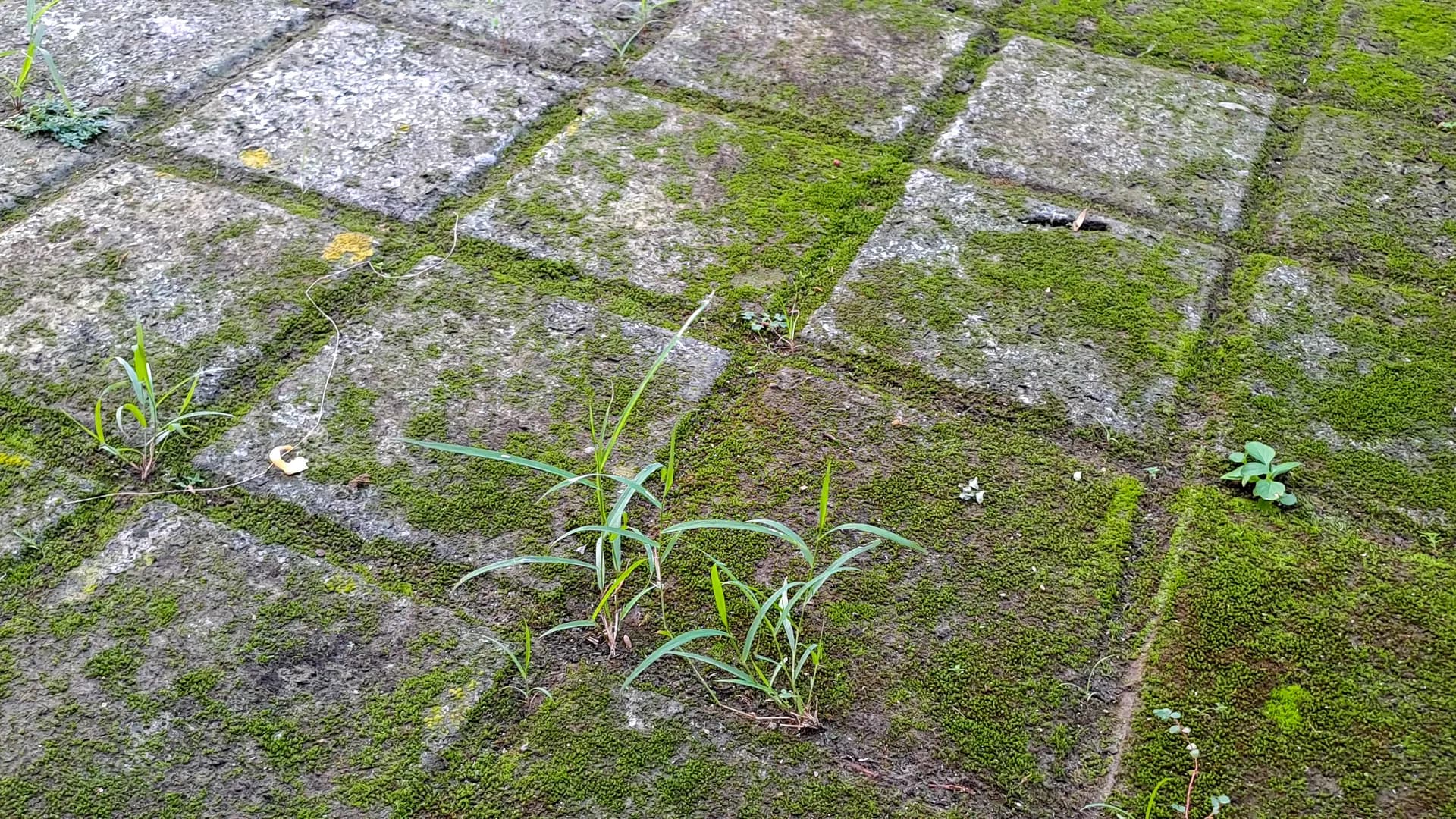
Moss, algae and lichen are three different organisms
People use the three words interchangeably. They are not the same thing and they do not respond to the same treatment. Which one you have decides the chemistry, the pressure, and the honest outcome.
Algae is the green or grey-black film on north and east walls, shaded concrete, and the lower courses of a fence. It needs only moisture and indirect light, has no root structure, and sits in the pores rather than gripping the surface. Algae is a staining problem more than a structural one, and it responds fast to chemistry — sodium hypochlorite at 0.5% with a biodegradable surfactant for cling, 5 to 10 minutes of dwell, gentle rinse.
Moss is the one that causes damage. It is a plant, not a film, with a dense mat of leaves and rhizoids that holds water like a sponge. A moss cushion in a shaded paver joint or on a north roof slope keeps the material underneath it permanently damp, including through the dry months when everything else finally gets to dry out. Moss does not really stain a surface. It wets it, continuously, which is a different category of problem.
Lichen is the hard, crusty, pale-green patch that will not come off at any pressure — a fungus and an alga living together as one organism, anchored into the pores with root-like structures. It needs a long dwell, sometimes a second application on a return visit. Force takes the surface with it.
Why moss is a moisture problem, not a cosmetic one
Water is what destroys exterior building materials, and moss is a device for holding water in place. Concrete that stays wet cycles through wetting and drying that lifts the cement paste off the surface — that sandy, crumbling texture is scaling. Wood above roughly 20% moisture content is wood rot fungi can colonize. Wet coatings lose adhesion from the back side long before they look like they are failing.
None of that happens because the moss is green. It happens because the moss will not let the surface dry.
Where it starts on a Sonoma Valley property
Rain concentrates between November and April, then summer marine fog pushes up the valley from San Pablo Bay and holds moisture against walls on summer mornings. Add the mature oak canopy most older Sonoma, Glen Ellen and Kenwood properties have, and the shaded side of a house never fully dries.
The colonization order is almost always the same:
- North-facing roof slopes first, then the eave edge and the valleys where debris collects
- Shaded pavers and flagstone, starting in the joints rather than on the stone
- The bottom twelve inches of a fence, where soil splash and irrigation overspray meet ground moisture
- Concrete under oak canopy, along the edges where water sits
Lower-valley properties in Boyes Hot Springs, Agua Caliente and El Verano show it earlier and heavier than properties up at Kenwood elevation. That is air movement, not neglect.
The consequence, surface by surface
Asphalt shingle roofs. Moss grows at the butt edge of the shingle and lifts it, holding water against the course below and letting it wick backward under the overlap. Scrape or blast it off and the ceramic granules that make the shingle UV-resistant come with it. The separate issue on asphalt is Gloeocapsa magma, the cyanobacterium behind black roof streaks — it eats the shingle's limestone filler, which is why streaks run vertically downslope.
Pavers and flagstone. Interlocking pavers depend on joint sand for structure. Moss loosens the joint and holds water in it; a high-pressure pass then flushes the sand out entirely. Edges settle, corners lift, and the repair costs several times the cleaning. Mortared flagstone is worse — a washed-out joint puts water under the stone.
Walkways and pool decks. A liability question, not an appearance one. Algae film on smooth concrete or coping is slick when wet, which is usually why people call about a shaded walkway or pool deck.
Wood decks and fences. Moss on a horizontal board keeps it wet year round, and rot shows first at the fasteners and board ends. Bare wood gets sodium percarbonate rather than hypochlorite — it breaks down into soda ash, water and oxygen, lifts the grey oxidized layer, and kills moss without pulling the warm tone out of redwood or cedar.
Why pressure washing alone makes it worse
High pressure removes what you can see and leaves the organism. The spore network and root-like structures live down in the pores, below where water pressure usefully reaches. Worse, the pass roughens the surface: open the texture of concrete, soften the surface fibers of wood, or strip a stucco finish coat, and you have handed the organism more surface area and better moisture retention than it had before. That is why a blasted surface looks clean for one season and comes back heavier the next.
The method that works inverts the intuition: kill it first, then remove what is left. On hard flatwork that is controlled mechanical cleaning paired with a biocide step — see pressure washing. On everything else it is soft wash only, under 500 PSI.
Treat it in spring, not in fall
Growth compounds. A thin algae film in April is a moss mat by the following March, because each season leaves a rougher, damper surface for the next to start from. The right window here is late spring, once the November-to-April rains have finished — a treatment in April or May clears the winter's accumulation and you get the dry months out of the result.
What moss removal costs
Moss and algae work starts at $295 for a single area — a shaded walkway, a driveway apron, one elevation of siding. Most jobs are combinations, since the organism rarely limits itself to one surface, and a full property typically lands between $750 and $1,200.
What a moss treatment will not fix
- Damage already done. Granule loss on a roof, scaled concrete and rotted deck boards are permanent. Cleaning stops the cause; it does not reverse the effect.
- Deep lichen staining on porous stone. The organism dies and releases, but on soft, open stone the anchor points can leave a faint shadow.
- The conditions that caused it. An irrigation head hitting the wall, a leaking gutter joint above it, or a shrub planted a foot off the siding brings the growth back on schedule. Those fixes cost almost nothing and matter more than the wash.
- White mineral deposits. Chalky bloom is efflorescence, not biology, and will not respond to a biocide at any strength.
Questions we get
- Why does moss come back so fast after most cleanings?
- Because most operators only treat the surface. The visible moss is maybe 20% of the organism — the rest is a network of spores and root-like structures embedded in the porous substrate. A pressure wash alone removes the visible part. The rest regrows within 60-90 days. That's why every Sonoma Wash Co. moss treatment includes a sodium hypochlorite finish — it kills the spore network.
- Can I just use bleach myself?
- Household bleach is too dilute and would require dangerous dwell times that damage adjacent landscaping. Industrial sodium hypochlorite at the right concentration, surfactant for cling, and a controlled application method is what makes commercial moss treatment effective. The chemistry isn't optional — it's the whole point.
- How long does treatment last?
- Properly treated, 12-18 months before any regrowth becomes visible. North-facing or heavily shaded surfaces are on the shorter end of that range; sunny well-drained surfaces are on the longer end. Most of our estate clients get treated in spring and fall.
- Is it safe for my landscaping?
- When applied correctly, yes. Pre-wetting plants saturates them so they can't absorb the cleaning solution. Post-rinsing dilutes any overspray. We've never killed a plant. If you have anything especially sensitive (orchids, exotic ferns), tell us before we start and we'll cover them.
- Is the treatment safe for my pets?
- Yes, once the surfaces are dry — typically 2-3 hours after rinse. We recommend keeping pets indoors during the actual treatment.
Often found alongside
Mildew & Mold Treatment
The dark streaks and patches on your stucco, painted siding, or shaded walls.
Read moreWildfire Soot & Ash Removal
The fine grey-black residue left on exteriors after a wildfire passes through Sonoma Valley.
Read moreRust Stain Removal
Orange-brown discoloration from sprinkler systems, metal furniture, or iron-rich water sources.
Read more