The problem
Mildew & Mold
Mildew is a fungal growth that thrives in moisture, shade, and organic debris — distinguishable from dirt by the dark green or black streaking that follows water drainage paths down the wall.
Get a quote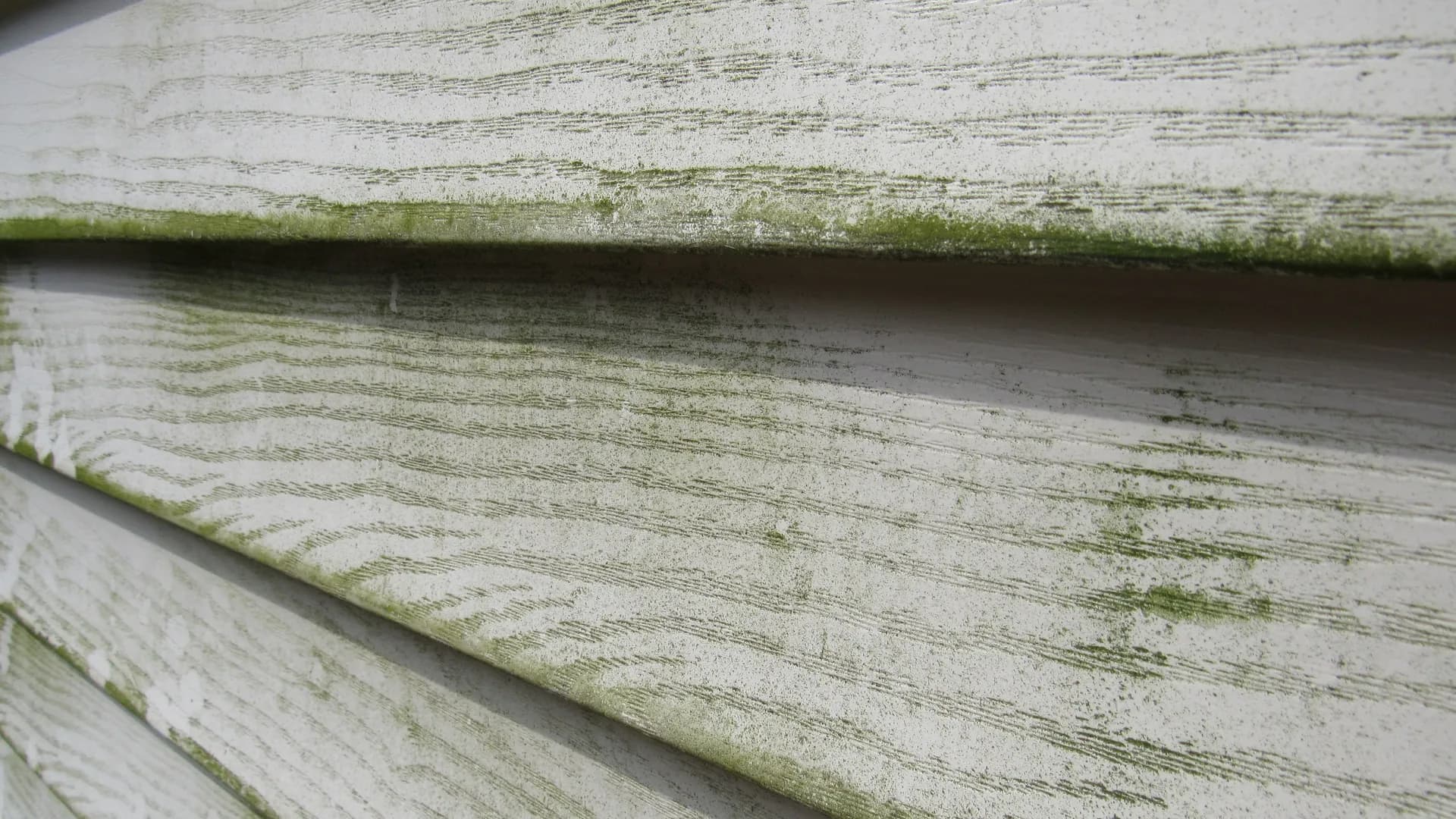
Exterior mildew is not the mold problem you have been reading about
Black staining on the outside of a stucco or painted wall is mildew: a surface fungus on the exterior face of the coating, out in the weather, feeding on the organic binders in paint and on the pollen, dust and oak debris that settle into the texture. It is separated from the air inside your house by the sheathing, the weather barrier and the wall assembly. It is a coating-life issue, and the fix is a wash.
Interior mold is a different problem. It grows on wet drywall, insulation or framing because water is getting into the assembly and staying there — a plumbing leak, failed flashing, a window that is not draining. That is a moisture investigation followed by remediation, and exterior washing does not touch it.
So: if the staining is outside and the inside of that wall is dry, you have a wash on your hands. If there is dampness, staining or smell on the interior side, go find the water.
Where it shows up, and why it is always the same places
Mildew needs moisture, shade, and something organic to eat. Sonoma Valley supplies all three. Rain concentrates between November and April, then summer marine fog pushes up the valley from San Pablo Bay and holds moisture against walls on summer mornings. Most older properties in Sonoma, Glen Ellen and Kenwood sit under mature oak canopy, which blocks the sun and drops a steady supply of organic debris onto the wall.
The pattern repeats on nearly every property we look at:
- North and east walls. Two shades darker than the south and west walls on the same house, same paint, same age.
- Under eaves and soffits. Shaded, never rinsed by rain, usually dirtier than the wall below.
- Behind shrubs and hedges. Anything planted within a foot of the siding kills air movement and traps humidity against it.
- Below irrigation overspray. A sprinkler head clipping the wall twice a day creates a growth band you can trace by hand.
- Under gutter joints and downspout seams. Growth follows the drip line, which is why it streaks vertically.
None of that reflects on how you keep your house. It is the climate, which is why a wash is maintenance rather than rescue.
What mildew is actually costing you
Mildew is not sitting inertly on your paint — it is eating it. Exterior coatings use organic binders to hold pigment and film together, and those binders are food. A wall left to grow for several seasons loses binder from the top of the film down, which shows up as early chalking, loss of sheen, and a coating that fails years ahead of schedule.
Treatment, surface by surface
All of these are a soft wash at under 500 PSI. What changes is chemistry, dwell, and where the risk lives.
Stucco. The most common siding in the valley and the least forgiving. It is a cement product with an open, porous surface, and that porosity is exactly why it discolors. High pressure erodes the finish coat into pits and wand-shaped swirls, and drives water past the finish into the paper and lath behind, where it has no fast way out. So stucco gets chemistry and a top-down rinse at garden-hose pressure, and hairline cracks get a rinse angle rather than a direct hit.
Painted wood siding. Clapboard, board-and-batten, T1-11. The wash protects the coating rather than threatening it, as long as the paint is sound. If it is lifting at the edges or chalking heavily, we say so before starting — cleaning accelerates a coating that is already finished.
Fiber cement. Hardie and similar planks are durable and forgiving, but growth hides in the embossed texture and along the bottom edge of every course. Dwell time, not pressure.
Vinyl. Easy to clean and easy to ruin, because the risk is the lap rather than the panel face. Every course hangs loose over the one below it, leaving a continuous open seam behind the wall. We wash top-down, spraying with the lap instead of up underneath it.
Cedar and bare wood. These get sodium percarbonate rather than hypochlorite. It breaks down into soda ash, water and oxygen, lifts the grey oxidized layer, and kills mildew without pulling the warm tone out of the wood.
Why chlorine, and why low pressure
The working blend is sodium hypochlorite at 0.5% with a biodegradable surfactant for vertical cling and a corrosion inhibitor for metal fixtures and fasteners. Dwell is 5 to 10 minutes depending on surface and buildup, then a gentle rinse carries off the dead organic matter. Landscaping is pre-wet before application and rinsed thoroughly afterward.
It has to be a biocide rather than just a detergent. A surfactant-only wash removes the visible film and leaves the organism intact in the pores — identical on the day, back within a season. Hypochlorite at the right dilution kills at the spore level, which is the difference between 18 to 24 months of clean wall and three months of it.
Concentration matters in both directions. Too dilute and the dwell required gets long enough to put landscaping at risk. Too strong and you bleach pigment out of the paint you are trying to protect.
What this costs
Mildew treatment starts at $325, which covers a single elevation or a small single-story footprint. A full soft wash typically runs $325 to $550 depending on height, access and how much growth is on the shaded side. If the whole envelope needs attention — siding, eaves, soffits, fascia and fixtures — that is a house wash and is quoted as one job.
What a mildew wash will not fix
- Interior mold. We are exterior-only. No interior mold remediation, no air-quality testing. If there is moisture inside a wall, the wash is not the fix — find the water first.
- Failing paint. If the coating is lifting or chalking heavily, washing accelerates it. Clean it, then plan to paint. A wash will not save a finish that is done.
- Permanent discoloration. Growth left for many seasons can stain porous stucco deeply enough that a wash lightens rather than erases it.
- White mineral bloom. Chalky deposits are hard-water scale or efflorescence and need acid, not a biocide.
- The underlying conditions. Trim the shrubs, aim the sprinklers away from the wall, fix the leaking gutter joint. Those three do more for a north wall over five years than any wash schedule.
Questions we get
- How do I tell the difference between exterior mildew and plain dirt on my siding?
- Mildew follows water. It runs downward in dark grey-to-black tracks from eaves, window sills and gutter joints, and it concentrates on north and east walls that never take direct sun. Dirt is distributed evenly and mostly rinses off with a garden hose, while mildew does not budge without a biocide. If a rag with a little dilute bleach on it lightens a test spot within a minute, you are looking at living growth.
- Is black mildew on my stucco dangerous to my family's health?
- Exterior mildew on a wall is not the indoor air quality problem people read about. It lives on the outside face of the coating, feeding on paint binders, pollen and oak debris, separated from the air you breathe by the sheathing and the rest of the wall assembly. The health question belongs to interior mold growing on wet drywall or framing, which is a remediation trade and something an exterior wash does not address.
- Will pressure washing get mildew off painted siding?
- It removes the visible film and leaves the organism alive in the pores, so the growth returns within a season. On painted siding, 2,500 to 4,000 PSI also strips coating, raises wood grain, and drives water behind laps and into the wall cavity. Mildew on paint is a soft wash job under 500 PSI, where a 5 to 10 minute dwell does the work instead of force.
- Why does mildew keep coming back on the same wall every year?
- Because the conditions that caused it are still there. In almost every case it is a north or east wall with no direct sun, an irrigation head throwing overspray onto the siding, a shrub planted within a foot of the wall, or a gutter joint leaking above it. Moving one sprinkler head and cutting shrubs back 18 inches often buys more than the wash does. Most Sonoma Valley homes want a wash every 18 to 24 months, and a shaded wall with a sprinkler on it may need it at twelve.
- Can you treat mildew without killing my landscaping?
- Yes. Plants and beds are saturated with plain water before anything is applied, so the foliage cannot take up the solution, then the ground and foliage get a thorough rinse afterward. The blend is sodium hypochlorite at 0.5% with a biodegradable surfactant and a corrosion inhibitor, which is more dilute than what goes into a swimming pool. Tell us before we start if you have anything unusually sensitive and we will cover it.
Often found alongside
Moss & Algae Removal
The green stuff on your driveway and shaded walls. It's more than a cosmetic issue.
Read moreWildfire Soot & Ash Removal
The fine grey-black residue left on exteriors after a wildfire passes through Sonoma Valley.
Read moreBird & Bat Dropping Removal
The white-and-grey staining on entry walls, awnings, and outdoor furniture. Removable, but time-sensitive.
Read more