METHOD · 02 OF 06
Pressure Wash
High-pressure cleaning for hard surfaces — concrete, fences, sealed stone, dumpster pads.
Get a pressure wash quote →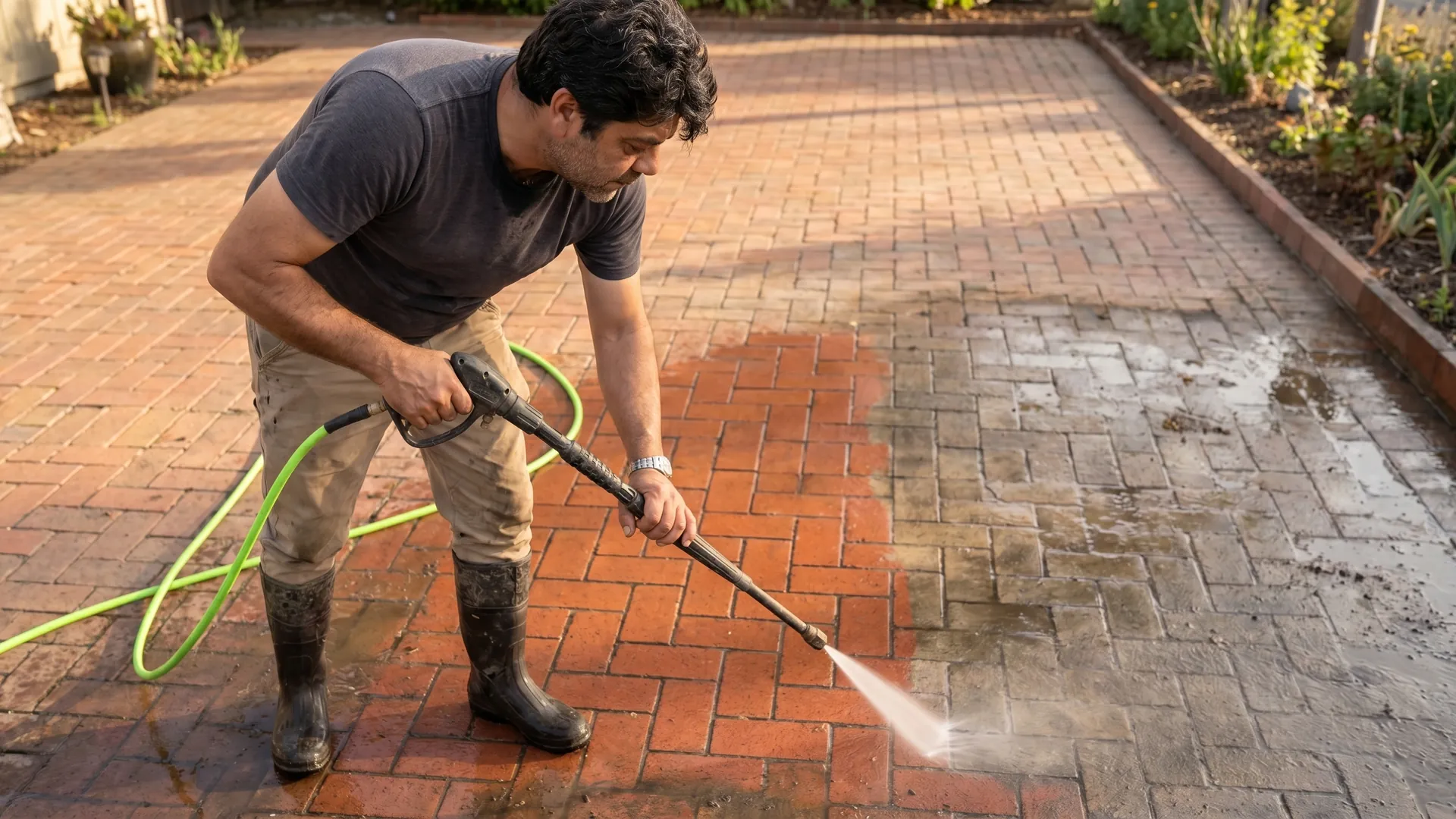
What pressure washing is actually for
Pressure washing is a mechanical process. Water at 2,500 to 4,000 PSI breaks the bond between a deposit and the surface under it, and the flow carries the debris away. No chemistry is doing the thinking. Force does the work, and force does not distinguish between the grime and the substrate under it.
That makes pressure the right tool on one category of surface: hard, dense material stronger than the water hitting it. Broom-finish concrete. Sealed stone and pavers. Brick and masonry with sound mortar. Commercial flatwork — parking aprons, loading zones, dumpster pads. Stamped and colored concrete, but only where the sealer is intact.
There, pressure beats the alternative. Soft washing lets chemistry kill biological growth, then rinses the dead material off at under 500 PSI. On a driveway with tire rubber ground into the pores and four winters of oak tannin on top, there is nothing for chemistry alone to lift. The deposit is physical, so the removal has to be too.
Surface cleaner versus wand
This is the biggest difference between a professional flatwork result and a rental unit.
A wand puts one narrow, high-energy stream on the surface and the operator moves it. Cleaning happens in a band two to four inches wide with feathered edges. Overlap imperfectly and you get stripes. Hesitate for half a second and you get a lighter arc where the stream dwelled and took the top layer of cement paste with it. Across a thousand square feet, those inconsistencies read as zebra striping the moment the slab dries, and they're effectively permanent — you can't fix striping by going back over it, only by eroding the whole surface to match the places you already eroded.
A flat surface cleaner is an enclosed housing with nozzles on a rotating bar, riding on casters at a fixed height. The bar spins at several hundred RPM, so every square inch under the housing takes the same number of impacts per second no matter how fast the operator walks. Fixed standoff, fixed angle, even energy. Uniform is the whole objective: a driveway that is evenly eighty percent clean looks far better than one that's ninety-five percent clean in stripes.
The wand still handles the perimeter a housing can't reach, edges against planting beds, steps, and spot work.
Nozzles and standoff
Tip selection is where most surface damage originates. The 0-degree red tip is a pencil jet that etches concrete, carves wood, and cuts mortar out of joints; it has no place on a residential property. 15 degree is narrow and aggressive, for spot work on sound masonry only. 25 degree is the general-purpose hard-surface tip — enough energy to clean, wide enough to blend. 40 degree is a wide, low-energy fan for rinsing. A rotary tip spins a 0-degree stream inside a cone: useful on a localized deposit on durable concrete, never on anything decorative.
Standoff matters as much as the tip: impact pressure falls off sharply as the gun moves away.
GPM matters more than PSI
PSI gets advertised because it sounds like power. Flow rate decides how long a job takes and how clean it ends up. PSI breaks the bond; GPM carries debris off the slab. Four GPM at 3,000 PSI cleans flatwork faster and more evenly than 2 GPM at 4,000 PSI, because the higher flow drives a wider surface cleaner and genuinely flushes loosened material away instead of letting the grey slurry dry back down as a film.
Hot water, for anything greasy
Temperature is the variable most residential operators skip, and it's non-negotiable on anything oily. Fats, grease, dropped food, gum, and bonded bird droppings don't respond to cold water at any pressure — it emulsifies grease slightly and redeposits it a foot downstream. Water at 180 to 200 degrees emulsifies it properly, so a degreaser can break it and the rinse can carry it off. Dumpster pads, loading zones, garage floors, and the oil drip zone in most driveways are hot-water work.
Pressure does not kill what's growing
This is the step most pressure-only services leave out. Moss, algae, and lichen anchor into the pores of the concrete. Pressure takes the visible layer and leaves the organism, which is why a blasted slab looks clean for one season and comes back worse — the surface is now rougher and holds moisture better than before.
So the mechanical pass is followed by a biocide rinse: sodium hypochlorite at 0.5 percent with a biodegradable surfactant and a corrosion inhibitor, 5 to 10 minutes of dwell, then a flush. That moves regrowth from a 60-day problem to a 12-to-18-month one. See moss and algae.
Where this comes up in Sonoma Valley
Rain concentrates November through April, then marine fog pushes up the valley from San Pablo Bay on summer mornings and holds moisture against flatwork long after the rain stops. Add the mature oak canopy most older properties in Sonoma, Glen Ellen, and Kenwood have, and the shaded half of a driveway never fully dries. The pattern repeats everywhere: the oak-shaded side of the slab green and slick, the sunny side merely dirty, a dark band along every lawn edge where irrigation oversprays. Lower-valley properties in Boyes Hot Springs, El Verano, and Agua Caliente show it earliest.
What we will not pressure wash
- Asphalt composition roofs. Pressure strips the ceramic granules that make a shingle UV-resistant and voids most manufacturer warranties. Roof algae is a soft wash, full stop.
- Bare softwood. Redwood, cedar, and treated pine survive roughly 200 PSI. Once the grain is fuzzed, the wood absorbs water differently for life. See deck and fence.
- Unsealed natural stone. Limestone, travertine, sandstone, and dry-set flagstone are soft and absorbent. Pressure pits the face and washes out the joints.
- Aging or recoated stucco. Pressure erodes the finish coat into pits and swirl marks and drives water into the lath. Elastomeric recoats are membranes; thinning one is how hairline cracks start weeping.
- Vinyl siding. Every course hangs loose over the one below, so there's a continuous open seam behind the wall. Pressure into a lap puts water on the housewrap, and it surfaces weeks later as interior staining.
- Unsealed paver joints. Pavers depend on joint sand for structure. Blast it out and edges settle, and the repair costs more than the cleaning.
- Decorative concrete with failed sealer. If the sealer is gone and the color is chalking, pressure takes pigment with it. We check first and tell you what we find.
If what you have falls into one of those, mention it when you request a quote and we'll price the right method rather than the convenient one.
Problems this solves
Moss & Algae Removal
The green stuff on your driveway and shaded walls. It's more than a cosmetic issue.
Read moreOil & Grease Stain Removal
The dark spots on your driveway, restaurant flatwork, or shop floor. Solvable, but the method matters.
Read moreRust Stain Removal
Orange-brown discoloration from sprinkler systems, metal furniture, or iron-rich water sources.
Read morePool Deck Buildup Removal
The discoloration, calcium deposits, and algae on the surfaces around your pool.
Read more