The problem
Rust Stains
Rust staining is iron oxide chemically bonded to the porous substrate — pressure washing alone won't touch it because the iron is fused to the concrete, not sitting on the surface.
Get a quote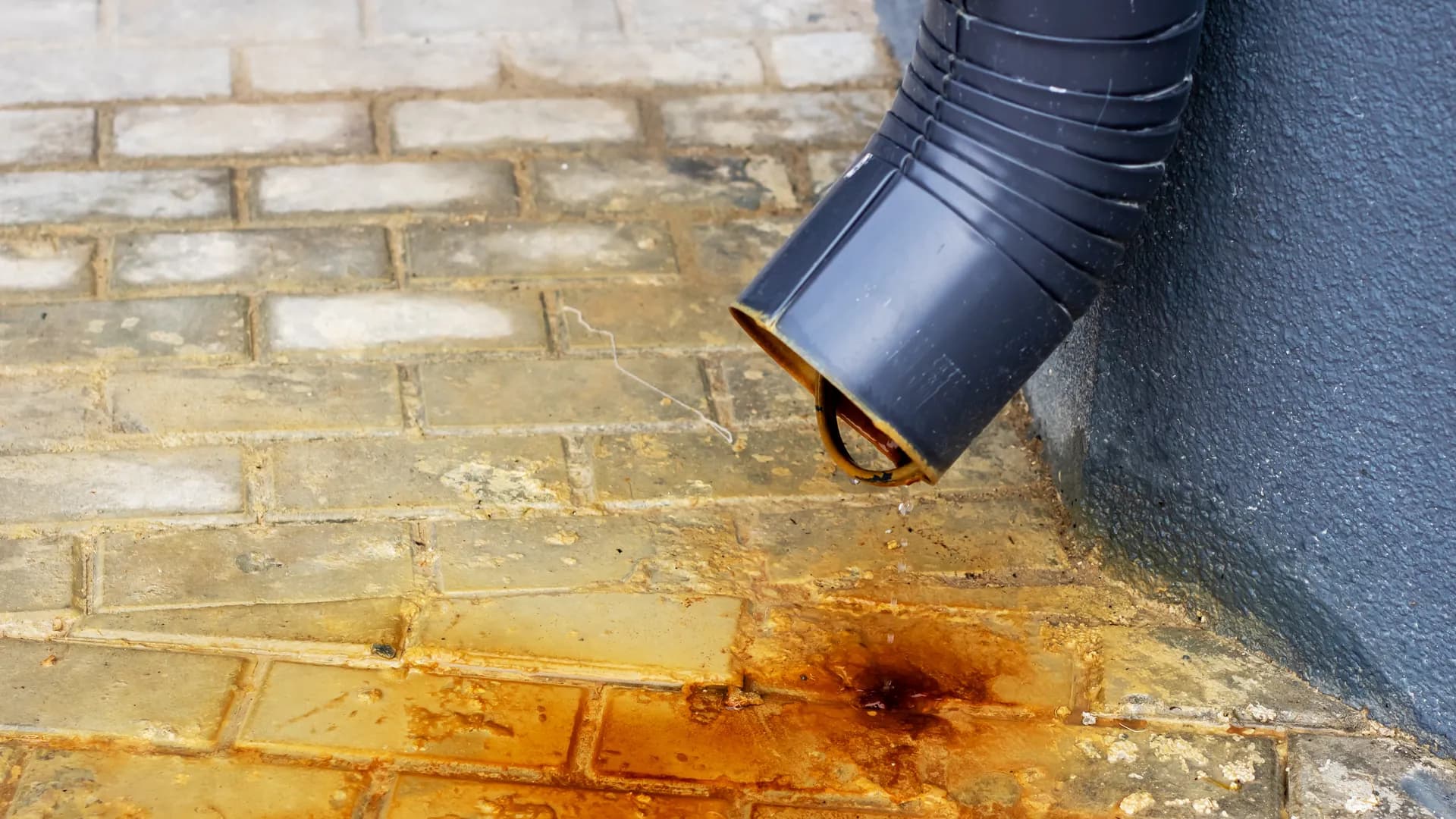
Rust is a chemical stain, not dirt
Rust staining on concrete or stone is iron oxide that has chemically bonded to the porous substrate. It is not sitting on top of the slab the way moss, pollen, or road film does. The iron has migrated into the capillary structure of the material and reacted with the calcium there, which is why it survived every wash anyone has already tried on it.
That distinction decides the entire job. Biological growth responds to a biocide — our standard blend is sodium hypochlorite at 0.5% — and chlorine does absolutely nothing to iron oxide. Dirt responds to pressure. Rust does not respond to pressure either, and the attempt does real damage: at 2,500 to 4,000 PSI you erode the cement paste off the top of the aggregate, leaving a lighter, cleaner-looking crater where the stain was. The surface inside that crater is rougher and thirstier than the slab around it. It will stain again, faster, this time with a wand-shaped halo around it.
Rust comes out chemically, or it does not come out.
Where the iron is actually coming from
The source determines the treatment and whether the stain stays gone, so it is the first thing we look at.
Irrigation and well water. The classic Sonoma Valley pattern. Much of the valley runs on wells or high-mineral irrigation water, and dissolved iron oxidizes the moment it meets air and concrete. The signature is unmistakable: an orange fan shape on a driveway, walkway, or stucco wall matching the arc of a sprinkler head exactly, darkest where the spray lands hardest. It builds a little with every watering cycle, which is why homeowners describe it as appearing gradually with no event behind it.
Fertilizer. Anything containing iron sulfate or chelated iron — most lawn greening products do — stains concrete the instant it gets wet. The usual version is a broadcast spreader rolled across a driveway, or granules tracked onto a walkway by a mower and then irrigated. Often the ugliest stains and the easiest to remove, because they are weeks old rather than years old and still sitting shallow.
Metal furniture and planters. Wrought iron chair feet, steel planter rings, a pot on a steel stand. Four small circles in a square pattern is almost always furniture that spent the November-to-April rains in one spot.
Rebar and embedded metal. In older concrete where the reinforcement sits too close to the surface, the steel itself corrodes and expands. The stain comes from inside the slab as a line or blotch, usually with a hairline crack or spalled edge along it.
Tannin bleed on wood. Dark rings around every screw head on a redwood, cedar, or pressure-treated deck. It looks like rust, but it is the wood's own tannins reacting with iron in the fastener — different reaction, same treatment family. See deck and fence cleaning for how it fits into a wood job.
Oxalic acid converts the stain, it does not scrub it
Oxalic acid is a chelating agent. Rather than abrading iron oxide off the surface, it binds to the iron and converts it to a water-soluble iron oxalate complex that can simply be flushed out of the pores. Nothing mechanical happens. The stain stops being a stain at the chemical level and then leaves with the rinse water.
We apply it at 5-10% concentration to the affected area on a pre-wet surface, with a dwell of 5 to 15 minutes — longer for older, deeper staining, repeated in passes rather than pushed to one aggressive application. Then two things that matter more than the acid itself: a neutralizing rinse to bring surface pH back up, and a long, generous flush with clean water. Acid left in the pores keeps working on the cement binder after we leave, and the result weeks later is a chalky, powdery patch. Sandstone and limestone get shorter dwells and more passes for the same reason.
Plants and metal get protected before anything is mixed — oxalic acid scorches foliage, and runoff into a bed of lavender is not a theoretical risk on a sloped Sonoma driveway.
What a realistic result looks like
Outcomes on rust fall on a gradient, and anyone quoting you "complete removal" sight unseen has not looked at your concrete.
- Fresh surface staining — fertilizer, furniture, a recent spill — usually goes to invisible in one application.
- Established irrigation staining on porous broom-finish concrete goes to dramatically reduced: expect 70-90% improvement and a faint shadow that reads only in low, raking sunlight.
- Decade-old staining on sandstone or limestone takes multiple applications, and the honest target is "no longer the first thing you see," not "gone."
- Rebar staining is a concrete problem wearing a stain costume. We can lift the surface discoloration, but the steel keeps corroding and the stain returns.
We tell you which bracket your stain is in while we are standing on it, before any number gets written down.
Fix the source or budget for it annually
Rust removal is a treatment, not a cure. If the iron is still being delivered, the stain comes back on the schedule it arrived on.
For the sprinkler pattern — the most common case from Sonoma and El Verano up through Glen Ellen and Kenwood — the fix is fifteen minutes of work: rotate the head, lower it, swap the nozzle for a narrower arc, or convert that zone to drip. Where the water itself is heavily iron-loaded, an inline iron filter is the durable answer. Keep iron furniture on glides, and keep iron-supplement fertilizer off hardscape — sweep before you irrigate, every time.
What this treatment will not fix
Being blunt about this up front saves a difficult conversation on the day.
- Etching from a previous acid or pressure job. That texture is permanent. We can clean it; we cannot put the cement paste back.
- Rebar and embedded-metal staining. Chemistry treats the symptom. The corrosion continues.
- Color loss in integrally colored or stamped concrete. Acid can lighten pigment. If the sealer has failed and the color is already chalking, we recommend against treatment.
- Hard water scale and efflorescence. Different chemistry entirely — see efflorescence.
- Moss, algae, and mildew. Biological, and they need a biocide, not an acid. Often on the same driveway as the rust, and a separate step in the same visit.
Pricing
- $75 per rust area treatment
- Typical project $295-$595
Rust treatment is priced as an add-on to a full driveway and concrete clean, because treating one orange patch on a grey slab just moves the problem — you end up with a clean spot inside a dirty driveway.
Questions we get
- Will a rust stain come out of concrete completely?
- It depends entirely on how old the stain is and how porous the concrete is. A fertilizer or furniture stain caught within a few weeks usually goes to invisible in one oxalic acid application; a sprinkler stain that has been building for five or ten years on unsealed broom-finish concrete typically goes to a 70-90% reduction, leaving a faint shadow visible only in raking light. We tell you which category yours is in before we quote, not after we treat it.
- Can I use a rust remover from the hardware store on my driveway?
- Most consumer rust removers are either too dilute to penetrate concrete or are hydrochloric-acid based, which dissolves the cement paste along with the iron and leaves a permanently etched, lighter patch that is more absorbent than the slab around it. Oxalic acid at 5-10% is the correct chemistry, and it needs a pre-wet, a controlled 5-15 minute dwell, a neutralizing rinse, and a long flush afterward. The acid is the easy part; the neutralization and rinse are where DIY attempts usually fail.
- Why does the rust stain on my driveway keep coming back?
- Because the iron is still arriving. In most of Sonoma Valley the culprit is well or high-mineral irrigation water, and if a sprinkler head is still throwing that water onto the concrete, the stain rebuilds within one or two watering seasons. Rotate or lower the head, swap it for a drip emitter, or put an iron filter on the line — otherwise you are buying this treatment annually.
- Does pressure washing remove rust stains?
- No. Rust is iron oxide chemically bonded into the pore structure, so there is nothing for 3,000 PSI to knock loose. What pressure does accomplish is eroding the cement paste off the top of the aggregate, which leaves a clean-looking crater that is rougher and more absorbent than the surrounding slab and restains faster. Sodium hypochlorite does nothing to rust either — chlorine is for biological growth.
- What are the dark rings around the screws on my deck?
- That is tannin bleed, not rust. Redwood, cedar, and pressure-treated pine contain natural tannins that react with iron in fasteners and leave a dark halo at every screw or bolt head. It is a different chemical reaction from iron oxide on concrete but it responds to the same oxalic acid brightener, applied after the deck wash and followed by a full rinse.
Often found alongside
Oil & Grease Stain Removal
The dark spots on your driveway, restaurant flatwork, or shop floor. Solvable, but the method matters.
Read moreEfflorescence Removal
The chalky white deposits on brick, stone, or stucco. Common, treatable, but not a "regular wash" problem.
Read moreMoss & Algae Removal
The green stuff on your driveway and shaded walls. It's more than a cosmetic issue.
Read more