METHOD · 03 OF 06
House Wash
Full-exterior cleaning for the entire envelope of your home — siding, eaves, fixtures, and the first impression every visitor gets.
Get a house wash quote →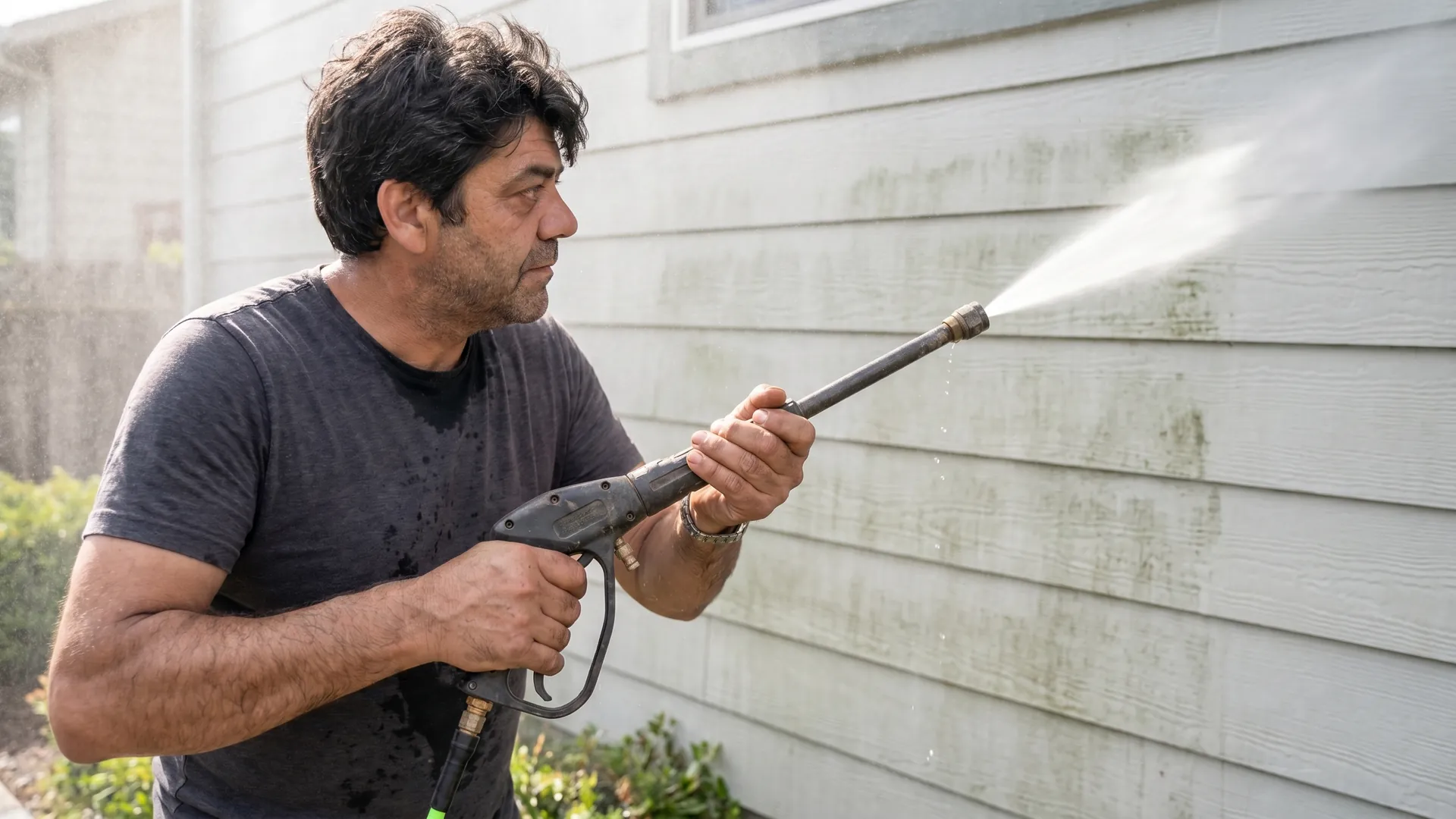
The process
- Walk the property · Identify problem areas (north walls, mildew concentrations, fixture issues).
- Protect landscaping · Pre-wet all plants, cover any sensitive species, rinse adjacent ground.
- Apply soft wash · Low-pressure application of biodegradable detergent, work top-down.
- Dwell · 5–10 minutes for the chemistry to break down biological growth.
- Rinse · House-hose pressure, top-down, no fuzzing or stripping.
- Detail · Fixtures wiped, gutters checked, walkthrough with you.
Why our house wash is different
Most house wash services blast siding with 2,500+ PSI to "save time." That's how stucco gets pitted, paint gets stripped, and your contractor ends up repainting in three years. We're slower. We use chemistry. Your siding lasts longer.
Stucco: the most common siding in Sonoma Valley, and the least forgiving
Stucco is a cement product with an open, porous surface, and that porosity is exactly why it discolors. Dust, pollen and oak debris settle into the texture, hold moisture, and feed mildew — which is why a stucco wall goes grey-black in patches rather than fading evenly.
The failure mode people bring us is almost always pressure damage from a previous wash. High pressure on stucco does two things, and neither one is reversible. It erodes the finish coat, leaving pits and wand-shaped swirl marks that read as a lighter halo once the wall dries. And it drives water past the finish into the paper and lath behind it, where it has no fast way out.
So stucco gets chemistry and a rinse, not force. Biodegradable surfactant, dwell time, and a top-down rinse at roughly garden-hose pressure. Three details decide the result:
- Elastomeric and acrylic coatings tolerate chemistry but not abrasion. If your stucco was recoated — common on 1980s and 1990s valley homes — the coating is a membrane. Scrubbing it thin is how hairline cracks start weeping.
- Hairline cracks get a rinse angle, not a direct hit. Stucco cracks from normal seasonal movement. Spraying straight into one injects water into the wall cavity.
- Weep screed at the base must stay clear. The slotted metal strip along the bottom of the wall is the drainage path. We rinse it, we don't pack it with runoff debris.
Vinyl siding, and the one thing nobody tells you about it
Vinyl is the easiest siding to clean and the easiest to ruin, because the risk is not the panel face — it's the lap.
Every course of vinyl overlaps the one below it and hangs loose on its nails so it can expand and contract. That means there is a continuous open seam behind the whole wall. Spray upward into those laps and water goes directly into the cavity and onto the housewrap. It does not come back out quickly, and the result is interior staining or mold that shows up weeks later and gets blamed on a roof leak.
We wash vinyl top-down, spraying with the lap rather than under it, at low pressure. Chalking is the other vinyl-specific issue: older panels oxidize into a powdery film that transfers to your hand, and it is worth knowing before we start that chalking is UV damage to the panel itself. A wash removes the loose chalk and makes the wall uniform; it does not restore the original pigment, and no wash can.
The rest of the envelope
Painted wood siding — clapboard, board-and-batten, T1-11. The wash protects the coating rather than threatening it, as long as the paint is sound. Mildew eats the organic binders in paint, so growth left in place is actively shortening the life of the finish. If the paint is already chalking heavily or lifting at the edges, we will tell you before we start: cleaning will accelerate a coating that is already done.
Fiber cement — Hardie and similar. Durable, stable, and forgiving, but the growth hides in the embossed texture and along the bottom edge of every plank. It takes dwell time rather than pressure.
Cedar shake and bare wood. These get sodium percarbonate instead of hypochlorite — it lifts the grey oxidized layer and kills moss without pulling the warm tone out of the wood.
Eaves, soffits and fascia. Shaded, never rain-rinsed, and almost always dirtier than the wall below them. They are also where wasp and mud-dauber nests live, which is a scheduling conversation and not something to discover mid-wash.
Fixtures, windows and gutter faces. Light fixtures get rinsed and hand-wiped. Window exteriors get rinsed, with a deionized-water rinse available if you want them to dry spot-free. The visible outside face of the gutter is included; the inside of the trough is gutter cleaning and is priced separately.
What a house wash does not include
Being specific about this up front saves everyone a difficult conversation on the day.
- The roof. Roof algae is a different mix and a different approach — see soft wash.
- The inside of the gutters. Scooping the trough and flushing the downspouts is its own line item.
- Window interiors or screen removal. We rinse the outside glass.
- Hard water spotting and efflorescence. White mineral deposits are not biological and will not respond to a biocide. That is an acid treatment, not a wash.
- Rust and tannin bleed. Metallic and organic stains need oxalic or an acid, not chlorine.
Timing and how often
Most Sonoma Valley homes want this every 18 to 24 months, and the variable is shade rather than anything about the wash. A fully sun-exposed wall can go three years. A north-facing wall under a live oak with an irrigation head hitting it may need attention at twelve months.
Late spring is the sweet spot. Homes come out of the November-to-April rains carrying the whole season's growth, so a wash in April or May means you get the summer out of it and your house looks right through the hot months when people are actually outside. If you are painting, book the wash first — a clean, sound surface is what the coating needs to bond to, and a painter working over mildew is painting a problem shut rather than solving it.
Properties with multiple buildings — guest house, barn, ADU, pool house — are each priced individually, but they are far cheaper done in one visit than in three.
Problems this solves
Mildew & Mold Treatment
The dark streaks and patches on your stucco, painted siding, or shaded walls.
Read moreMoss & Algae Removal
The green stuff on your driveway and shaded walls. It's more than a cosmetic issue.
Read moreWildfire Soot & Ash Removal
The fine grey-black residue left on exteriors after a wildfire passes through Sonoma Valley.
Read moreBird & Bat Dropping Removal
The white-and-grey staining on entry walls, awnings, and outdoor furniture. Removable, but time-sensitive.
Read more