METHOD · 06 OF 06
Gutter Cleaning
The maintenance task that prevents the most expensive damage.
Get a gutter cleaning quote →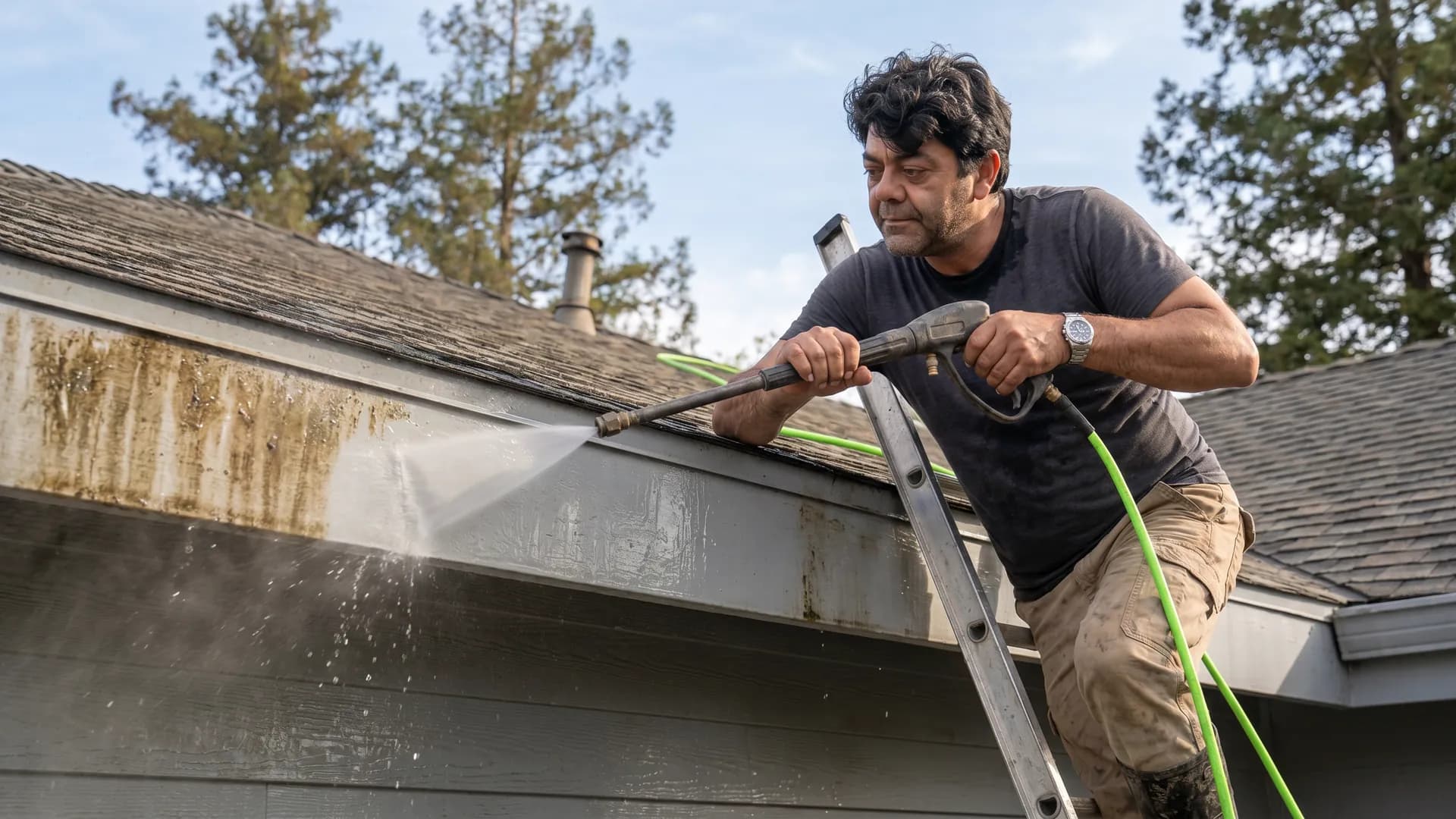
This is building damage, not curb appeal
Every other service on this site is about how a property looks. Gutter cleaning isn't. A gutter is water-management infrastructure, and when it stops working the damage happens in materials you can't see from the ground and doesn't announce itself until it's expensive.
A thousand square feet of roof under an inch of rain moves more than six hundred gallons of water, and the gutter's job is to catch it at the eave and route it away from the building. When the trough is packed, the water finds another path, and every path runs through something you'd rather it didn't.
Fascia rot. A clogged trough holds a saturated mass of decomposing leaf litter against the fascia board, and the rot starts on the hidden back face. By the time there's a soft spot or a hanger that won't hold a screw, the board has been failing for seasons — and rotten fascia stops holding the gutter, which is how a full gutter becomes a detached one in the first storm.
Overflow at the wall head. When water tops the back edge of a gutter rather than the front, it runs down the wall exactly where the roof meets it — the worst place on a building for water to be. It gets behind the flashing, onto the underlayment, or into the sheathing. The symptom is an interior ceiling stain, blamed on the roof.
Foundation and crawlspace moisture. Without a working gutter, roof water lands in a concentrated line a foot from the foundation. In a crawlspace house — most older Sonoma, Glen Ellen, and Kenwood properties — that saturates the soil and raises crawlspace humidity for months. That's how you get mildew in a space nobody looks at and standing water every February.
Freeze-thaw on a packed trough. Valley winters don't build ice dams the way a cold climate does, but overnight lows at the bottom of the valley do reach freezing. Water trapped in debris expands as it freezes, and the pressure works at the seams, end caps, and sealant. A trough that drains freely has nothing in it to freeze.
The process
The method matters here, because the fast version of this job creates the next problem.
- Hand-scoop the trough. Debris comes out into a bag rather than getting flushed down the run. Flushing a packed trough is how a loose clog becomes a compacted plug halfway down a downspout.
- Bag it and take it. The debris leaves with us. No piles on the lawn.
- Flush and verify flow. Clean water down each run, watching for standing water — which means the gutter has lost its pitch — and watching every downspout to confirm it's moving.
- Check every downspout outlet. A downspout discharging at the base of the wall is doing a fraction of its job. We flag any that dump against the building or back up into a buried line.
- Inspect and reseat the hardware. Loose hangers get reseated where they can be. Separated seams, failing end caps, sagging runs, and visible fascia rot get shown to you.
- Photo report on request. The inside of a gutter is the one part of your house you've never seen. Ask and you'll get pictures.
Oak and redwood make this a twice-a-year job
Most of the country cleans gutters once, in late autumn, after the deciduous leaves drop. That schedule doesn't fit here.
Coast live oak is evergreen and sheds year-round rather than in one event, with a heavy push of small leathery leaves in late spring — exactly when a homeowner assumes gutter season is over. Those leaves are waxy and slow to break down, so they mat rather than pile. In February and March the oaks drop catkins: thin, stringy flower spikes in volume, and the most reliable downspout clog in Sonoma Valley. Redwood needles pack tighter still and wick water.
A gutter is also a shaded trough, and summer marine fog off San Pablo Bay keeps it damp on mornings that look dry. Moss and algae colonize the debris mat and bind it together, so what should be a loose pile lifts out in pieces.
Practically: once before the rains, in October or November, and once after the spring drop. A property with a mature oak overhead sometimes wants a mid-winter check, because one catkin plug takes a run out of service for the season.
Gutter guards, honestly
Guards help. They don't solve it, and anyone telling you they eliminate maintenance is selling guards.
A decent screen or micro-mesh keeps out the debris that causes gross blockage — whole oak leaves, redwood branchlets, the tennis ball. That genuinely reduces how often the trough needs clearing, and it's real value.
What they don't stop is fine material. Oak catkins, redwood needles, pollen, roof grit, and wildfire ash pass straight through most micro-mesh, or sit on top of it in a mat that blocks water as effectively as a clog would. Because the guard has to come off to inspect underneath, the gutter quietly stops draining while the homeowner assumes it's handled.
If you have guards, keep them — but plan on inspection anyway, and expect it to take longer.
Inside the trough versus the outside face
Two different jobs, and worth knowing which you're buying.
The inside is this service: scooping, flushing, hardware.
The outside face is the band you see from the street, and the dark streaks on it are tiger striping — oxidized paint binder mixed with roof runoff and grime, chemically bonded to the finish, which is why rinsing doesn't remove it. It needs a dedicated cleaner and hand work, and it's included in a house wash; standalone, it's priced per linear foot as an add-on above.
Why bundling costs less
If we're already on the property doing a house wash, the gutters add a fraction of the time, so bundled pricing is lower: $145 instead of $195 on a single-story home, $225 instead of $295 on a two-story. That isn't a promotional discount — it's the real difference in what the work costs once the ladders are already up.
What we don't do
- No roof repair. If the flashing is wrong or the underlayment is compromised, that's a roofer. We'll tell you what we saw.
- No gutter replacement, rehanging, or re-pitching. We'll reseat a loose hanger. A run that has lost its pitch or a separated seam needs a gutter contractor, and we'll say so rather than caulking over it.
- No underground drain-line clearing. A blocked buried downspout line is a drain service.
- No painting over rot. If the fascia is soft you'll hear it from us plainly. Nobody is served by a clean gutter hung on wood that won't hold it.