METHOD · 04 OF 06
Driveway & Concrete
The flatwork that gets the most use, the least attention, and the worst aging.
Get a driveway quote →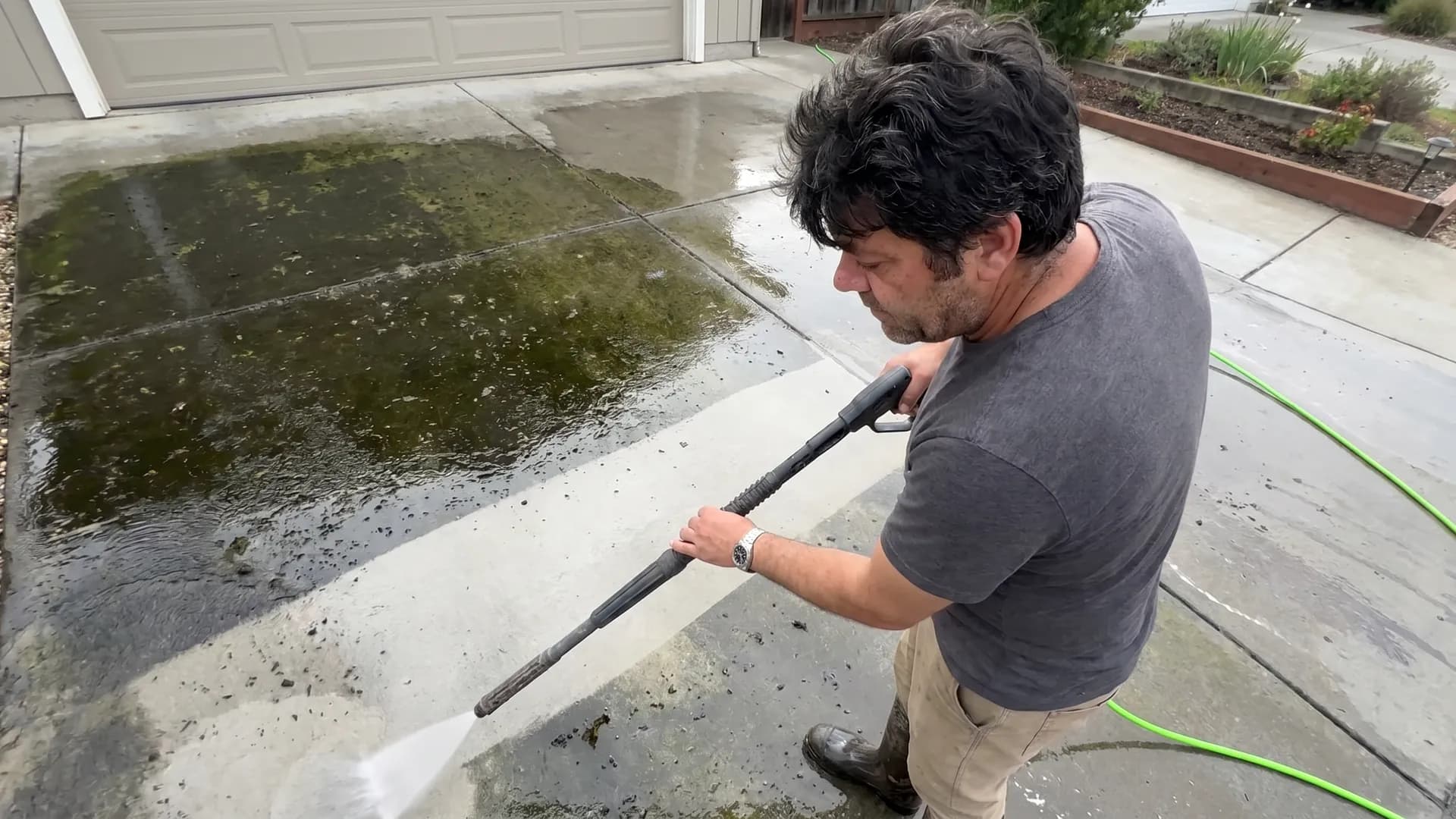
Concrete is a sponge, and that explains everything
Cured concrete looks solid and isn't. Capillary pores run through the cement paste at the surface, and on a broom finish they're open to the air — which is why a driveway darkens within seconds of rain.
That porosity is the whole reason driveway stains behave the way they do. Almost nothing that discolors concrete sits on the slab. Oil wicks into the pores. Tire rubber is pressed into them under the weight of a vehicle. Moss and algae anchor into them and hold water there. Oak tannin dissolves in rainwater and travels down with it.
It's also why people conclude their driveway can't be cleaned: they rinse it, the slab looks better wet and identical dry, and they give up. Getting the stain out means flushing the pores, not rinsing the face.
The method
Flatwork gets a surface cleaner, not a wand. A 21-inch housing with nozzles on a rotating bar rides on casters at a fixed height, so every square inch takes the same number of impacts per second regardless of how fast the operator walks. A wand leaves permanent zebra striping wherever the passes overlap imperfectly. It handles the perimeter, edges, steps, and spot work; tooling detail is on the pressure wash page.
Then the step that decides how long the result lasts. Pressure removes the visible moss and algae and leaves the organism alive in the pores, which is why a pressure-only wash starts coming back within about 60 days — into a surface now rougher and better at holding moisture. So the mechanical pass is followed by a biocide rinse: sodium hypochlorite at 0.5 percent with a biodegradable surfactant and a corrosion inhibitor, 5 to 10 minutes of dwell, then a flush. Kill the spores and the same slab holds 12 to 18 months. Landscaping is pre-wet and rinsed after.
The stains are not one problem, they're five
Tire marks and plasticizer bleed. The black scuffs are rubber transferred under load. The wider blotchy patches where a car parks regularly are plasticizers migrating out of the tire compound into the concrete, driven by a hot slab in summer. Scuff comes off with a degreaser and the surface cleaner. Plasticizer bleed has soaked in and needs a dedicated degreaser with dwell and hot water — it lightens substantially rather than vanishing.
Oil and transmission fluid. Caught within a few weeks, oil comes out almost completely: a solvent degreaser to break it, hot water to keep it emulsified, and enough flow to carry it off the slab instead of spreading it. A ten-year-old shadow where a truck has always parked has migrated millimeters down, below where any surface treatment reaches. We can lift it noticeably and even out the halo, but we won't tell you it will disappear, because it won't. See oil stains.
Rust and irrigation staining. Orange streaks fanning across a slab in a sprinkler pattern are iron in the water, not dirt. Well water in parts of the valley carries enough dissolved iron to stain concrete in one season, and the same chemistry shows up under metal furniture feet and around shallow rebar. Chlorine does nothing to a metallic stain; it needs oxalic acid, neutralized and rinsed — see rust stains. If the source is still running, cleaning buys one season.
Tannin and leaf staining. Oak is the signature Sonoma Valley stain. Leaves and catkins sit on a damp slab, rainwater pulls the tannins out, and you're left with brown blotches shaped like the debris that caused them. Tannin is organic but not alive, so the biocide rinse doesn't touch it. It responds to an oxalic brightener instead.
Efflorescence. The chalky white bloom near a garage apron or at the low edge of a slab is salt — not dirt, not biological. Water moving through the concrete dissolves free lime, carries it up, evaporates, and leaves the mineral behind. Washing redistributes it and it returns with the next wet cycle, because the cause is moisture inside the slab. It needs a dilute acid treatment and an honest look at where the water is coming from — see efflorescence.
Add-ons
- Oil stain treatment: $45 per stain (up to 3 sq ft)
- Rust removal (oxalic acid): $75 per area
- Concrete sealing (after cleaning): $0.85/sq ft, separate visit
- Walkway extensions: $1.85/linear ft (3' width)
Sealing is the decision that comes after
Sealing closes the pores that caused the problem. On a sealed slab, oil beads instead of wicking, tannin rinses off instead of soaking in, and moss has far less to anchor into. It's the most effective thing you can do to a clean driveway.
It's also a separate visit, and the reason is dry time. Sealer has to go onto concrete that's dry all the way through the surface layer, not just dry to the touch — 24 to 48 hours after a wash in good Sonoma summer weather, longer on a shaded slab. Sealer over trapped moisture clouds, blushes white, or delaminates within a year, and removing failed sealer costs more than applying it did.
On stamped or colored concrete, we check the existing sealer first. If it has failed and the color is chalking, pressure will take pigment with it.
Timing in Sonoma Valley
Flatwork comes out of the November-to-April rains carrying the whole season's growth, so April or May is the sweet spot: you get the summer out of the wash, and the slab gets the dry weather it needs if you're sealing after.
What decides how often you need it is shade and water, not the wash. A sun-exposed driveway in Kenwood can go two years looking fine. A north-facing slab under a live oak in Boyes Hot Springs with an irrigation head clipping the edge wants attention at twelve months — summer marine fog off San Pablo Bay keeps those sections damp on mornings that look bone dry.
What a driveway cleaning will not fix
- Cracks, spalling, and failed control joints. Cleaning makes existing damage more visible, not less. We'll show you what's there.
- Deep, aged oil. Real improvement is realistic. Complete removal on a decade-old stain is not.
- Paint, sealer overspray, and dropped epoxy. Coatings, not stains. They need stripping, not washing.
- Discoloration from the pour itself. Mottling from inconsistent curing, or a patch poured years later, is in the concrete rather than on it.
- Rust whose source is still running. Fix the sprinkler head or move the furniture, then clean.
If you're unsure which category your problem falls into, send a photo with your quote request. It beats a guess over the phone.
Problems this solves
Moss & Algae Removal
The green stuff on your driveway and shaded walls. It's more than a cosmetic issue.
Read moreOil & Grease Stain Removal
The dark spots on your driveway, restaurant flatwork, or shop floor. Solvable, but the method matters.
Read moreRust Stain Removal
Orange-brown discoloration from sprinkler systems, metal furniture, or iron-rich water sources.
Read moreEfflorescence Removal
The chalky white deposits on brick, stone, or stucco. Common, treatable, but not a "regular wash" problem.
Read more