Pressure Washing vs Soft Washing: Which One Your Surface Actually Needs
Top takeaways
- Pressure washing uses high PSI to blast away dirt and grime, effective for hard surfaces like concrete and pavers.
- Soft wash house cleaning relies on low pressure (typically under 100 PSI) combined with detergent to kill organic growth without damaging delicate surfaces.
- The material decides the method — asphalt shingles, stucco, and composite decking require different approaches than driveways and walkways.
- Choosing the wrong method can strip protective coatings, tear wood fibers, or leave biological growth to return within one season.
- Understanding what your surface is made of prevents costly damage and ensures the cleaning lasts.
Explore pressure washing vs soft washing to determine the best method for your surface cleaning needs.
Introduction to Pressure Washing vs Soft Washing
Soft wash house cleaning uses low-pressure water and chemistry to remove organic growth without damaging delicate surfaces. Pressure washing relies on high PSI to blast away dirt from hard materials like concrete. The surface material determines which method protects your home while delivering results that last.
The north side of your roof has gone dark and the south side has not. That is not dirt and it is not shade. It is a cyanobacterium, and it is eating the filler in your shingles. The method you choose to remove it will either preserve the granules that protect the asphalt or strip them off and shorten the roof's life by years.
When deciding between pressure washing and soft washing, the surface material is the only thing that matters. Pressure washing blasts away grime with high PSI — often 2,000 to 3,500 pounds per square inch. It works on concrete, brick, and stone because those materials can take the force. Soft wash house cleaning uses low pressure combined with detergent to kill organic growth like algae and mildew, relying on chemistry and dwell time rather than mechanical force.
Most of the damage I see was done by someone who picked a method before they looked at what the surface was made of. A pressure washer will clean a redwood fence, but it will also fur the surface and open the grain so that it greys again in one season. A soft wash will remove the black streaking on an asphalt roof without taking the granules with it, but it will not touch the oil stain on your driveway.
Understanding What Soft Wash House Cleaning Involves
A soft wash house cleaning uses a 12-volt pump that delivers 60 to 100 PSI — less pressure than a garden hose at full flow. The cleaning happens in the chemistry, not the force. A surfactant breaks the surface tension so the solution can penetrate, and sodium hypochlorite kills the algae, mold, and bacterial film at the root. You apply it, let it dwell for ten to fifteen minutes, and rinse it off with low pressure.
The care sheet for most siding materials specifies a maximum pressure and a minimum distance. Many crews ignore both. Vinyl siding is rated to 1,200 PSI at twelve inches, but that is the failure threshold, not a working pressure. Stucco and EIFS have no pressure rating at all because they are not designed to be blasted. The label on the cleaning solution provides a recommended dwell time and concentration — follow it, or you will bleach the surface rather than clean it.
The material decides the method. If the surface can be damaged by water under force, or if the problem is biological rather than mechanical, soft wash house cleaning is the correct choice. If the surface is dense, non-porous, and the contamination is embedded or oil-based, pressure washing is the tool. There is no single answer — only the one that matches what you are actually cleaning.
What is Pressure Washing?
Pressure washing is a mechanical cleaning method that uses high-pressure water to blast dirt, grime, and stains off hard surfaces. The machine forces water through a nozzle at pressures typically ranging from 1,500 to 4,000 psi. The higher the psi, the more force hits the surface. That force is what does the work — it strips away buildup without relying on chemistry or dwell time.
The method works well on dense, non-porous materials that can take the impact. Concrete driveways, brick pavers, and stone patios are good candidates. The surface is hard enough that the water pressure removes the contamination without tearing into the substrate itself. You adjust the pressure and the nozzle angle based on what you are cleaning, but the principle stays the same: mechanical force, not chemical action.
When Pressure Washing Works
Pressure washing handles heavy buildup on surfaces that will not be damaged by the impact. Oil stains on a concrete driveway, mud on a paver patio, or years of grime on a stone foundation — these are jobs where high pressure makes sense. The surface is already dense and durable, and the contamination is sitting on top rather than growing into the material.
You are also paying for speed. A pressure washer covers a lot of ground quickly when the surface can take it. For large flat areas like driveways or commercial walkways, that efficiency matters. The trade-off is that you are limited to surfaces that can handle the force without damage.
Limitations and Risks
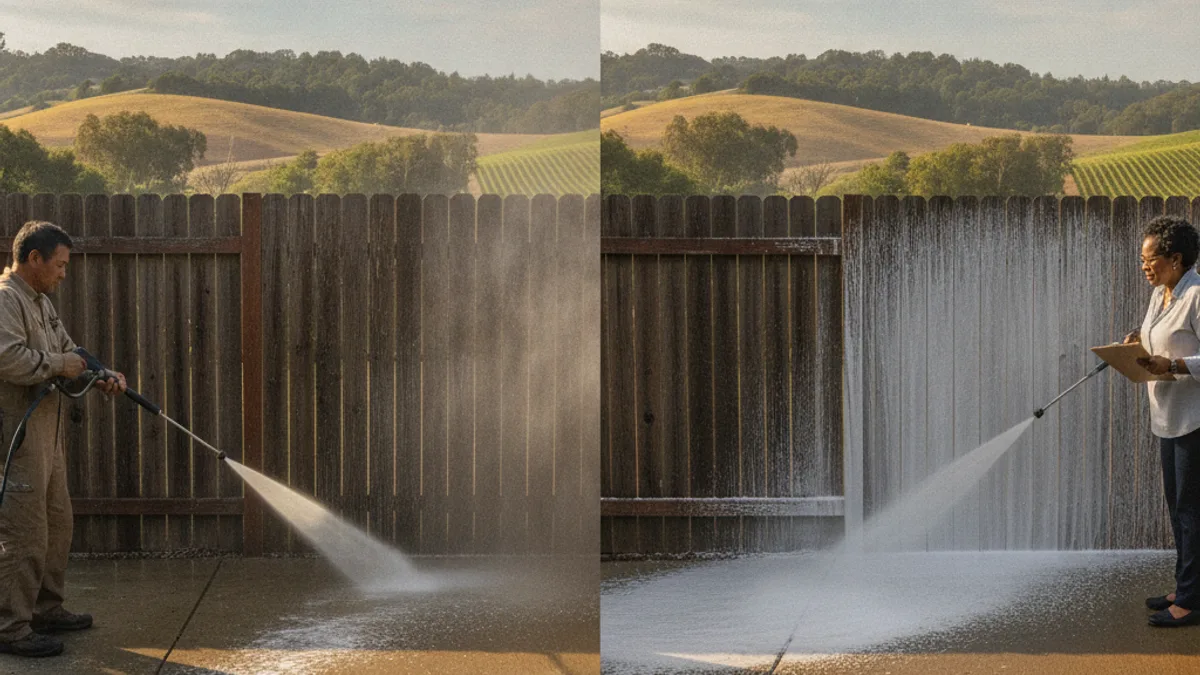
The problem with pressure washing is that the force that cleans a driveway will destroy a roof. Asphalt shingles, stucco, wood siding, composite decking — these materials cannot take 3,000 psi without damage. On an asphalt shingle, the pressure strips off the granules, which are the shingle's sunscreen. On a redwood fence, it furs the surface and opens the grain, so the wood greys faster after cleaning than it did before.
Pressure washing also does not kill biological growth. It removes the visible layer, but it does not address the root structure. Algae, moss, and lichen will come back faster after pressure washing than they would after a proper soft wash, because the organism is still alive underneath. You get a clean surface for a season, then the problem returns.
The other risk is operator error. Most of the surface damage I see was done by someone running too much pressure or holding the wand too close. Once you tear the surface, you cannot put it back. Test in a corner first, and if you are not certain the surface can take it, stop.
What is Soft Washing?
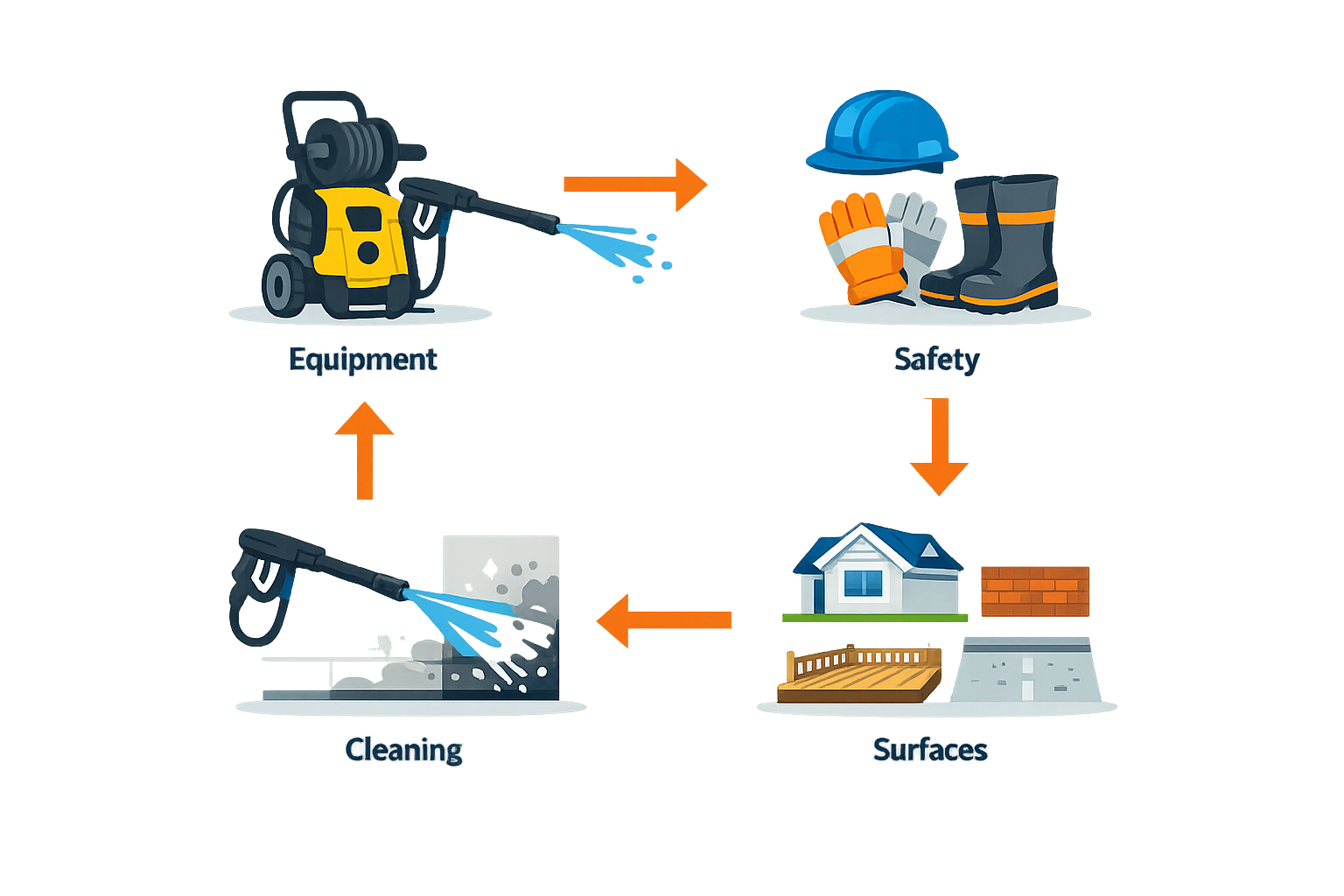
Soft washing is a low-pressure cleaning method that uses chemistry instead of force. Where pressure washing relies on high PSI to blast away grime, soft washing runs at under 500 PSI and lets a surfactant and sodium hypochlorite solution do the work. The detergent breaks down organic growth — algae, moss, mildew, and that black streaking on north-facing roofs — and the low-pressure rinse carries it away without tearing into the surface.
The material decides the method. Asphalt shingle, stucco, painted siding, composite decking and redwood all have a threshold pressure above which you are doing damage. Soft washing keeps you below that line. The chemistry kills the organism at the root, so the surface stays clean longer than it would after a high-pressure blast that only strips the visible layer.
How Soft Washing Works
A soft wash rig delivers cleaning solution through a low-pressure pump — typically a 12-volt diaphragm or a gas-driven unit running at garden-hose pressure. The surfactant wets the surface and lifts dirt. The hypochlorite oxidizes organic matter. Dwell time is the variable that matters: the solution sits on the surface long enough to break down what is growing there, then you rinse it at a pressure safe for the substrate.
The label on the cleaning solution specifies concentration and dwell time. Most residential exterior work uses a 1–2% sodium hypochlorite solution after dilution. Let it sit for ten to fifteen minutes, keep the surface wet, then rinse from top to bottom. If you rinse too soon, you are just moving dirty water around. If you let it dry on the surface, you will see streaking.
What Soft Washing Is For
Soft washing is the right method for any surface where high pressure would strip a protective layer or open the grain. Asphalt shingles lose granules under a pressure washer; those granules are the shingle's sunscreen, and once they are gone the mat deteriorates faster. Painted wood siding, stucco and EIFS all have a finish coat that high pressure will peel or pit. Composite decking has a polymer cap over a wood-flour core — abrade the cap and you expose the core to moisture and UV.
Biological growth comes back because the organism is still alive under the visible layer. Soft washing kills it. Algae, moss, lichen and gloeocapsa magma all feed on the substrate or on atmospheric dust that settles into texture. A surfactant and oxidizer solution breaks down the cell structure. The surface stays clean through the next dry season because there is no live growth left to recolonize it.
The chemistry kills the organism at the root, so the surface stays clean longer than it would after a high-pressure blast.
I soft wash roofs, siding, fences and any painted or coated surface. I do not soft wash concrete, pavers or heavily soiled driveways — those need mechanical action, and the substrate can take it. The question is always what the surface is made of and what is happening to it. If the problem is biological and the material is porous or finished, soft washing is the answer.
Understanding Surface Materials and Their Needs
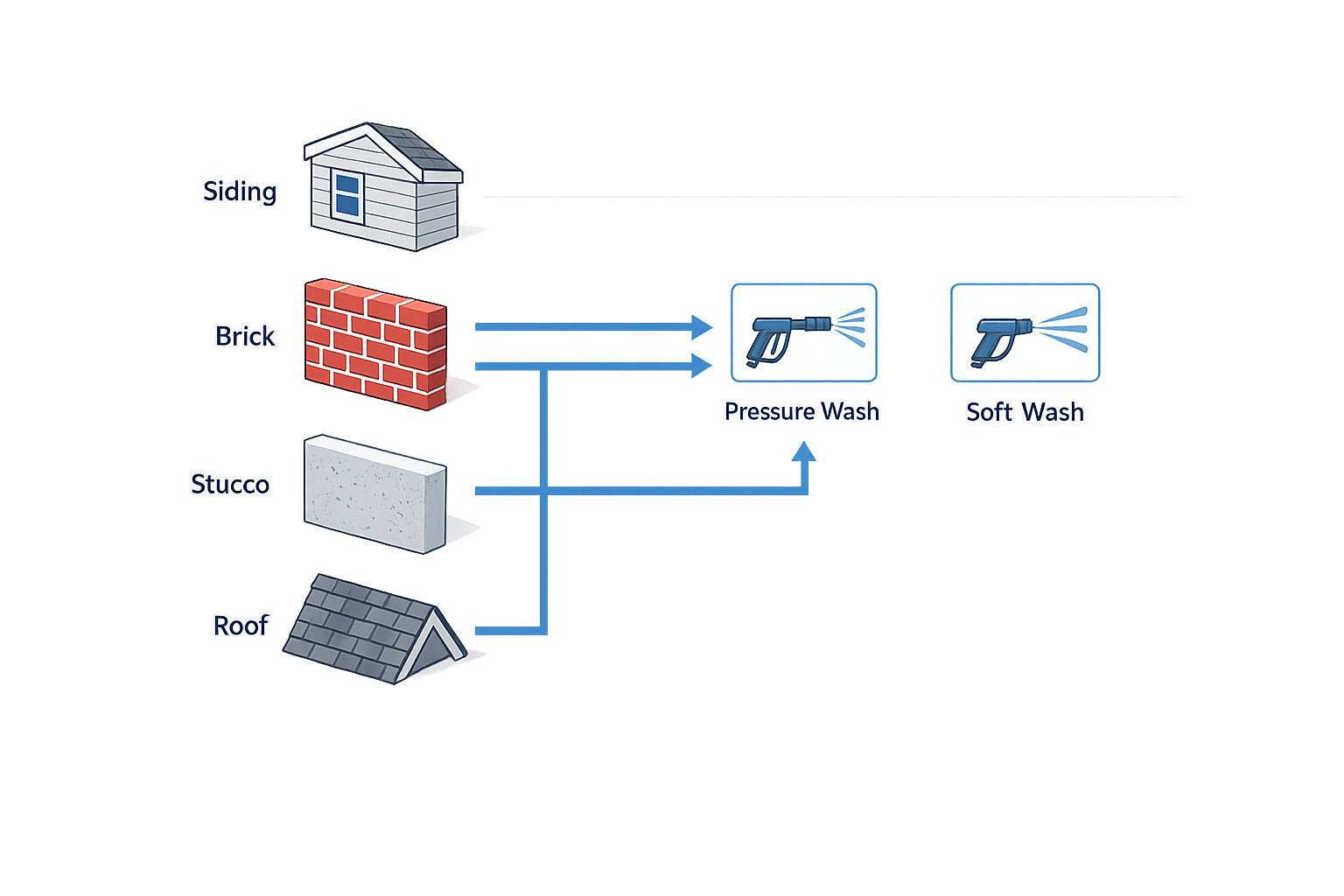
The material decides the method. Every exterior surface is built from something specific, and that something has a failure mode. Asphalt shingle roofs have granules embedded in the mat; those granules are the shingle's sunscreen. Strip them off and the asphalt cooks. Wood siding has grain and pores; open them with high pressure and they grey faster than they did before. Stucco is a cement-based render over wire lath; blast it and you drive water behind the plane where it cannot dry.
I see more damage from the wrong method than I do from neglect. A house that sat dirty for three years is still a house. A house that took 3,000 psi on the wrong surface is a repair job.
Asphalt Shingle Roofs
Asphalt shingles are a fiberglass or organic mat saturated with asphalt and coated with ceramic granules. The granules protect the asphalt from UV. When you pressure wash a shingle roof, you strip granules. The shingle loses its protection and fails early. The black streaking you see on north-facing roofs is gloeocapsa magma, a cyanobacterium that feeds on the limestone filler in the shingle. It is biological, not mineral, so it responds to chemistry, not force.
Soft wash house cleaning is the only method that cleans the organism without damaging the substrate. A surfactant and hypochlorite solution with enough dwell time kills the growth at the root. Rinse it gently and it stays clean for several seasons.
Wood Siding, Decks and Fences
Wood is a bundle of cellulose fibers. The surface you see is end grain and face grain. High pressure tears the fibers, raises the grain, and leaves a furred surface that traps dirt and moisture. Redwood and cedar have natural oils that resist decay, but those oils sit in the cell structure. Blast the cells open and the oils leach out faster.
I will not put 3,000 psi on a redwood fence. You will get a clean fence and a furred surface that greys again in one season. A soft wash with a mild surfactant and a low-pressure rinse leaves the grain intact. If the wood is already weathered and you want to prep it for stain, a controlled pressure wash at 500–800 psi with a wide fan tip will remove loose fiber without destroying the surface. Test it in a corner first.
Stucco and Painted Surfaces
Stucco is a three-coat or one-coat cement plaster. It is porous and it is applied over building paper and lath. The finish coat is thin. Pressure washing stucco at close range erodes the finish, exposes aggregate, and drives water through cracks into the wall cavity. Once water is behind the stucco, it has no path out, and you get efflorescence, staining and eventual delamination.
Painted surfaces fail at the bond between paint and substrate. High pressure lifts paint at any weak edge. If the paint is already failing, pressure washing accelerates it. A soft wash cleans the surface without testing every square inch of adhesion.
Composite Decking
Composite decking is a wood-flour and polymer blend with a factory cap. The cap is a dense polymer layer that resists staining and fading. It is also thin. Everything about cleaning composite follows from the fact that the cap cannot be restored once it is abraded. Pressure washing composite at high psi or with a narrow nozzle cuts through the cap and exposes the core, which stains and fades.
A soft wash with a deck cleaner formulated for composite, followed by a low-pressure rinse, removes organic staining without touching the cap. If the composite has mold or mildew in the texture, increase dwell time rather than pressure.
Concrete, Pavers and Stone
Concrete, pavers and natural stone are the only common exterior surfaces where pressure washing is the default method. Concrete is a hydraulic cement with aggregate. It is dense, non-porous when properly finished, and it does not have a surface that can be removed. Pressure washing concrete at 2,500–3,500 psi with a surface cleaner removes oil, tire marks, and organic growth efficiently.
Pavers and flagstone are similar. They are hard, they do not have a finish coat, and they respond to mechanical cleaning. The joint sand between pavers can be displaced by a zero-degree nozzle at close range, but a 25-degree tip at 12 inches will clean the face without washing out the joint.
The surface decides the method. Ask what the material is made of before you ask what pressure to run.
If the concrete is stamped or acid-stained, treat it as a decorative finish. The color layer is thin and pressure washing can remove it. Test it in an inconspicuous area, and if the color lifts, switch to a soft wash.
When to Use Pressure Washing vs Soft Washing
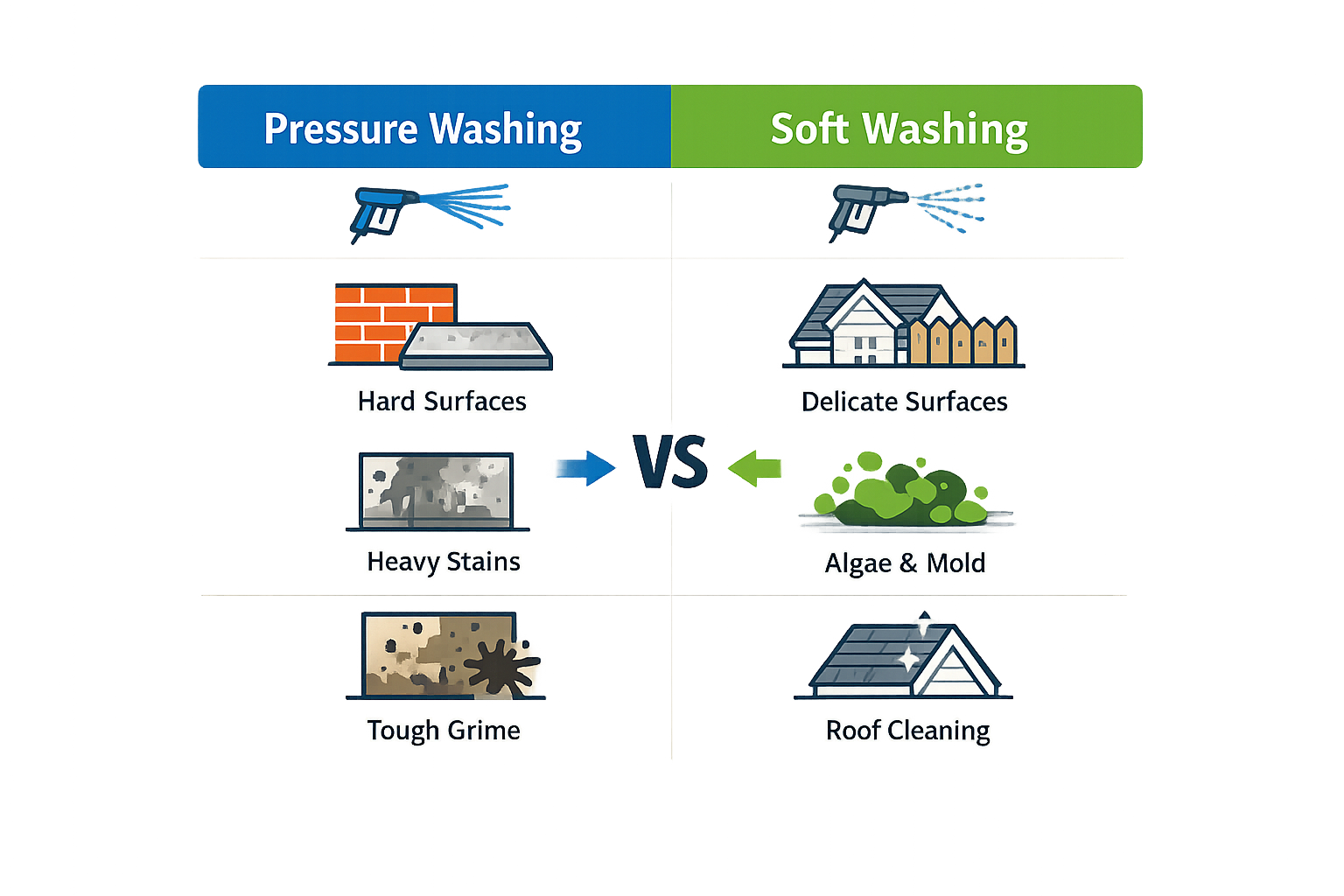
The surface decides the method, not your preference or the equipment you already own. Pressure washing works by mechanical force — it strips dirt off with water velocity. Soft wash house cleaning works by chemistry — it kills biological growth and dissolves organic film, then rinses it away at low pressure. If you choose wrong, you damage the substrate or waste time reapplying the same treatment six months later.
Use Soft Washing for Roofs, Siding, and Painted Surfaces
Asphalt shingle roofs get soft washed, period. The black streaking on a north-facing roof is gloeocapsa magma, a cyanobacterium that feeds on the limestone filler in the shingle. Pressure washing removes the granules along with the organism. The granules are the shingle's sunscreen — once they are gone, the asphalt degrades faster. A soft wash with sodium hypochlorite kills the cyanobacterium at the root and rinses clean at under 500 psi.
Stucco, painted wood siding, and composite trim also get soft washed. High pressure drives water behind the finish coat or into the wood grain. On composite decking with a factory cap, pressure opens the surface and accelerates weathering. The cap cannot be restored once it is abraded.
Vinyl siding tolerates more pressure than stucco, but it still has seams. Water forced behind the panel can sit against the sheathing and rot the framing. If the siding is dirty from algae or mildew, soft wash it. If it is only dusty, rinse it at low pressure with no chemical.
Use Pressure Washing for Concrete, Pavers, and Bare Wood
Concrete driveways, sidewalks, and patio slabs get pressure washed. Oil stains, tire marks, and ground-in dirt do not respond to surfactant alone — they need mechanical removal. A surface cleaner (a rotating bar under a shroud) delivers even pressure and eliminates striping. For oil, pre-treat with degreaser, let it dwell, then run the surface cleaner over it.
Pavers and natural stone get the same treatment as concrete, but watch the joint sand. High pressure erodes the sand and destabilizes the surface. Keep the wand moving and do not dwell in one spot.
Bare wood fences and decks can be pressure washed if you control the pressure and the nozzle angle. I run 1,200 to 1,500 psi with a 25-degree tip, held at a consistent distance. Go higher or closer and you fur the grain — the surface looks clean immediately, then greys faster because the torn fibers hold moisture. If the wood is painted or stained, soft wash it instead.
Most of the fence damage I see was done by a pressure washer. The wood looks clean for a season, then greys faster than it did before, because the surface has been torn open.
When the Surface Has Heavy Biological Growth
If a roof, wall, or deck is covered in moss, lichen, or thick algae, soft wash house cleaning is still the correct first step. Pressure washing removes the visible growth but leaves the root structure and spores in place. It grows back within months. Soft washing kills the organism, and the dead material rinses away. On a heavily colonized surface, you may need to apply twice — once to kill it, a second time after a few days to lift the residue.
On concrete with embedded lichen, you can soft wash first to kill the organism, then pressure wash to remove the stain it left. The two methods are not opposed — they address different problems. The chemistry handles the biology; the pressure handles the mechanical removal.
When to Walk Away from Either Method
Some surfaces should not be cleaned at all. If a wood fence or deck is so weathered that the grain is raised and the boards are cupping, cleaning it will not restore the surface. It will only expose more damaged wood. Tell the client to replace the boards or leave them alone.
If an asphalt shingle roof has lost most of its granules, soft washing will clean it but will not stop it from failing. The roof needs replacement, not cleaning. I will clean it if the client understands that, but I will not sell it as a preservation measure.
Single-season cosmetic algae on a concrete path does not need professional treatment. A stiff brush and a bucket will handle it. Leave it if it does not bother you — it is not structural.
Common Mistakes in Choosing Between Pressure Washing and Soft Washing
Most of the damage I see was done by someone who picked a method before they looked at the surface. The wand does not decide what is safe. The material does.
The biggest error is running high pressure on anything that can be abraded, delaminated or driven into by water. Vinyl siding, composite decking, any painted surface, asphalt shingle — these all fail in predictable ways when you hit them with 3,000 psi. The second mistake is assuming that because a surface is hard, it needs pressure. Stucco is hard. It is also porous. Drive water behind it and you are creating a problem that will not show up until the next winter.
Ignoring What the Surface Is Made Of
People treat all siding as though it were the same thing. It is not. Redwood, fiber cement, vinyl and stucco each have a failure mode. Redwood furs when you blast it. Vinyl siding has a seam every few feet, and water under pressure will find it. Stucco has a scratch coat, a brown coat and a finish coat, and the finish coat is the thinnest one.
If you do not know what the substrate is, you should not be pointing a wand at it. Test a corner. See what happens. If the surface changes texture or color, stop.
Using Pressure When Chemistry Will Do the Job
The other common mistake is using mechanical force when a surfactant and dwell time would handle it. Algae, mold and lichen are biological. They respond to chemistry. Blasting them off tears the surface. A low-pressure rinse after the solution has had time to work leaves the substrate intact.
I see this most often on roofs. The black streaking on a north-facing asphalt shingle roof is gloeocapsa magma, a cyanobacterium. It feeds on the limestone filler in the shingle. People pressure-wash it because it looks like dirt. What they take off is the granules, which are the shingle's sunscreen. The roof looks clean for six months, then it fails faster than it would have if you had left it alone.
Not Asking What Pressure the Contractor Is Running
When you hire someone, ask what pressure they are running and what tip they are using. If they say "we just use what works," that is not an answer. A 2,500 psi machine with a 40-degree tip at two feet is not the same thing as a 4,000 psi machine with a 15-degree tip at six inches, even though both are called pressure washing.
The distance matters as much as the pressure. A zero-degree tip will cut wood at close range. A 40-degree fan spreads the force and is safe on most hard surfaces if you stay back. If the contractor cannot tell you these numbers, do not let them start.
Choosing Based on Price Alone
The cheapest bid is usually the one that skips the prep, uses the wrong method and leaves before you see the result. You are not paying for the spray. You are paying for the operator to know what the surface is, to set the equipment correctly and to stop if something is going wrong.
A soft wash house cleaning costs more than a pressure wash in labor time, because the dwell time is longer and the rinse has to be thorough. If someone quotes you the same price for both, they are not doing one of them correctly.
FAQ
Can I soft wash house siding myself, or should I hire a professional?
You can soft wash your own siding if you are comfortable working from a ladder and you understand the chemistry. The surfactant and hypochlorite mix is not complicated, but the label on the bottle gives you the dilution ratio and the dwell time for a reason. If you skip the dwell or rinse too soon, you are wetting the surface without cleaning it. If you let it sit too long on painted wood or stucco, you risk lightening the finish.
The equipment is a pump sprayer or a small electric unit running under 100 psi. That is low enough that you will not damage the siding, but it is also low enough that you will spend time on the ladder. Most of the work is in the prep and the rinse, not the spray. If the house is two stories or the siding is in poor shape, a contractor with a larger pump and more hose will finish it faster and with less risk of a fall.
How often should I pressure wash my driveway?
Once a year is typical for a concrete driveway in regular use. If you park cars on it and it sees oil drips, you may want to do it twice. If the driveway is in full sun and you do not have a lot of tree cover, once is enough.
The black streaks and tire marks are embedded in the top layer of the concrete. A surface cleaner running at 3,000 psi will lift them without digging into the slab. If you see the driveway going green with algae or moss, that is a sign that water is sitting on it longer than it should. Check the grade and make sure it is draining. Cleaning it more often will not fix a drainage problem.
What is the difference between PSI and GPM, and why does it matter?
PSI is pounds per square inch — the force hitting the surface. GPM is gallons per minute — the volume of water moving through the system. Both matter, but they do different jobs.
High PSI with low GPM gives you a hard stream that cuts into the material. That is useful for stripping paint or cleaning a small, tough stain, but it is slow and it can damage soft surfaces. High GPM with moderate PSI gives you a lot of water moving across the surface quickly. That is what you want for rinsing and for covering large areas like driveways or decks.
For soft wash house cleaning, you want high GPM and very low PSI — enough flow to rinse the chemistry off completely, but not enough pressure to force water under the siding or into the roof deck. A 5 GPM pump at 60 psi will rinse a house faster and more thoroughly than a 2 GPM pump at the same pressure.
Will pressure washing damage my roof?
Yes, if the pressure is too high or the nozzle is too close. Asphalt shingles have a top layer of ceramic granules embedded in the asphalt. Those granules are the shingle's sunscreen — they reflect UV and protect the asphalt underneath from breaking down. When you hit a shingle with 3,000 psi from two feet away, you strip the granules off. The shingle looks clean, but you have shortened its life.
The black streaking you see on a north-facing roof is gloeocapsa magma, a cyanobacterium that feeds on the limestone filler in the shingle. It is not dirt. The right way to remove it is with a soft wash — low pressure, a surfactant to break the biofilm, and sodium hypochlorite to kill the organism. You apply it, let it dwell for ten minutes, and rinse it with low pressure. The roof comes clean and the granules stay in place.
If someone offers to pressure wash your roof, ask what pressure they are running and how far they hold the wand from the surface. If they say anything over 500 psi or they do not give you a number, find someone else.
Can I use the same method for all exterior surfaces?
No. The material decides the method. Concrete, brick, and stone pavers can take 3,000 psi without damage, so pressure washing is efficient and safe. Asphalt shingles, stucco, painted wood, composite decking, and vinyl siding cannot. Those surfaces need low pressure and the right chemistry.
Redwood and cedar fencing is a common place where people damage the house. The wood is soft, and high pressure will fur the surface — it looks clean for a season, then it greys faster than it did before because you have opened the grain. A soft wash with a wood cleaner and a stiff brush will clean the fence without tearing it up.
Composite decking has a polymer cap over a wood-flour core. Once you abrade the cap, you cannot restore it. The deck will stain more easily and it will fade unevenly. The manufacturer's care sheet specifies a maximum pressure and a maximum temperature for the water. Most crews ignore it. You should not.
What should I do if I see streaking or discoloration after cleaning?
If the streaking appears right after the cleaning, it is usually residual soap or hypochlorite that was not rinsed completely. Go back over it with plain water at low pressure. If the surface is porous — stucco, unsealed concrete, bare wood — give it a day to dry, then check it again. Sometimes the streaking is moisture wicking out of the substrate, and it will even out as it dries.
If the discoloration is lighter than the surrounding area and it does not rinse away, the chemistry sat too long or the concentration was too strong. That is a bleach mark, and it is permanent on painted or stained surfaces. On bare wood, it will fade over a season as the wood weathers. On stucco or concrete, it may fade slightly, but it will not disappear.
If you see the streaking a week or two after the cleaning, and it is darker than the rest of the surface, that is new growth. The surface was not treated, or the treatment did not dwell long enough to kill the organism. You will need to clean it again, and this time let the chemistry sit for the full dwell time before rinsing.
Conclusion: Making the Right Choice for Your Surface
The surface decides the method. Pressure washing cleans concrete, pavers and hard substrates where mechanical force does the work. Soft wash house cleaning cleans roofs, siding, stucco and wood where chemistry does the work and high pressure does damage. Most of the problems I see come from running the wrong method on the wrong material — blasted shingles, furred redwood, stripped composite caps.
When deciding between pressure washing and soft wash house cleaning, it is crucial to understand what each method entails and how it affects the surfaces you are working with. The care sheet for these materials often specifies the maximum pressure and distance to maintain, which many crews overlook. By respecting these guidelines, you ensure the longevity and appearance of the surface. The label on cleaning solutions provides a recommended dwell time and concentration, which should be adhered to avoid bleaching the surface rather than cleaning it.
If the substrate is porous, biological or has a factory finish, start with soft wash house cleaning. If it is dense, mineral and stained with oil or rust, pressure washing is the tool. Test a corner first. Ask what pressure the contractor is running and what chemistry they are using. If they cannot answer both, do not let them point a wand at your house.
The cleaning solution used in soft washing continues to work after the rinse, which is why dwell time matters more than pressure. Pressure washing removes what is on the surface right now. Soft wash house cleaning removes what is on the surface and kills what would grow back next season. Choose the method that matches the material, and the surface will last longer than it would under the wrong approach.