How to Remove Moss From Pavers Without Damaging the Joints
Top takeaways
- Moss grows on pavers because it finds moisture, shade, and porous surfaces to anchor into
- The joints between pavers are the weakest part of the system — aggressive cleaning damages them first
- Manual brushing, low-pressure rinsing, and the right chemistry remove moss without tearing out sand or polymeric fill
- Timing matters: clean moss in the dry season before the first rain sets it deeper into the substrate
- Most moss damage I see was caused by the cleaning method, not by the moss itself
Introduction
To remove moss from pavers effectively, start with manual brushing and low-pressure methods that preserve the joint sand. Moss is a plant that grows on pavers, and it is cosmetic. It does not eat the paver and it does not push the joints apart. What damages pavers is the method people use to remove it. I have pulled up polymeric sand that was blasted loose by a pressure washer, and I have seen joint fill washed clean out of a grid because someone ran 3,000 psi down the seams. The moss comes back. The joint does not.
How to Remove Moss From Pavers Without Damaging the Joints
Removing moss from pavers is a question of what the joint is made of and how much force it can take. Polymeric sand hardens when wet, but it is still sand — it will erode under direct pressure. Traditional sand has no binder at all. If you point a turbo nozzle at either one, you will get a clean paver and a ruined joint. The material decides the method.
This is where most people damage the patio. They rent a pressure washer, set it to max, and work down the grid like they are cleaning concrete. Pavers are not a monolith. They are individual units held in place by edge restraint and joint fill. Take the fill out and the pavers move. Once they move, the whole field can shift, settle, or lip.
I would rather scrub moss by hand than repair a joint I blasted apart. A stiff brush and a bucket will do it if the moss is light. If it has been there more than one season, you need chemistry and dwell time, not pressure.
The Problem of Moss on Pavers
Moss is a velvety green plant with no flowers, roots or stems. It attaches to the surface and absorbs water directly through its leaves. On pavers, that means it is holding moisture against the stone and in the joints between them. The longer it sits there, the more damage it does.
Why Moss Grows Where It Does
Moss prefers shade, poor air circulation and surfaces that stay damp. North-facing patios, walkways under eaves and courtyards between buildings check all three boxes. If the pavers are not getting sun and the joints are not draining fast, moss will settle in. Once it establishes, it spreads.
What Moss Does to Paver Joints
The joint between pavers is filled with sand or polymeric sand. Moss grows into that sand, displacing it and breaking down its structure. When the sand erodes or washes out, the pavers shift. You get low spots, trip hazards and uneven drainage. The longer the moss sits, the more joint material you lose.
Moss also holds water in the joint longer than the paver was designed to handle. In a freeze, that water expands and cracks the stone. In Sonoma County we do not freeze often, but we do get long wet seasons. Saturated joints grow algae, efflorescence and more moss. The cycle accelerates.
The Temptation to Blast It Off
Most of the paver damage I see was done by someone trying to clean them. A pressure washer set too high will scour the moss out of the joint and take the sand with it. You get a clean paver and an empty joint. The pavers rock when you step on them, and the moss comes back faster because there is less sand to compete with.
The surface of the paver matters too. Natural stone, concrete and clay all abrade differently. If you do not know what the paver is made of, you do not know what pressure it will take. Test it in a corner first, or use a method that does not rely on force.
Steps to Remove Moss from Pavers
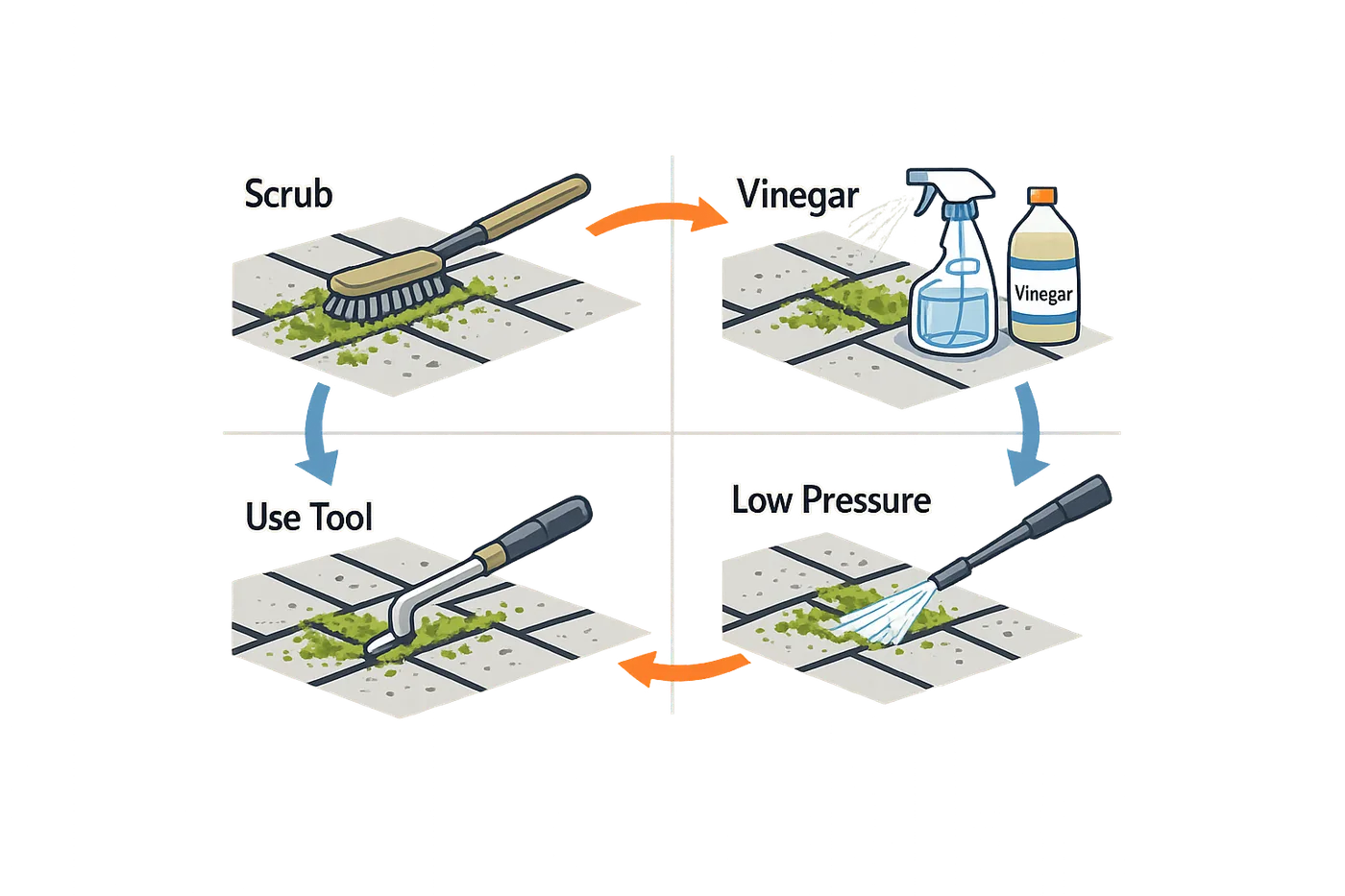
The method you choose depends on how much moss you have and how much joint material you are willing to risk. Every approach trades speed against joint preservation. I will walk through the options in order of gentlest to most aggressive.
How Do You Manually Remove Moss From Pavers?
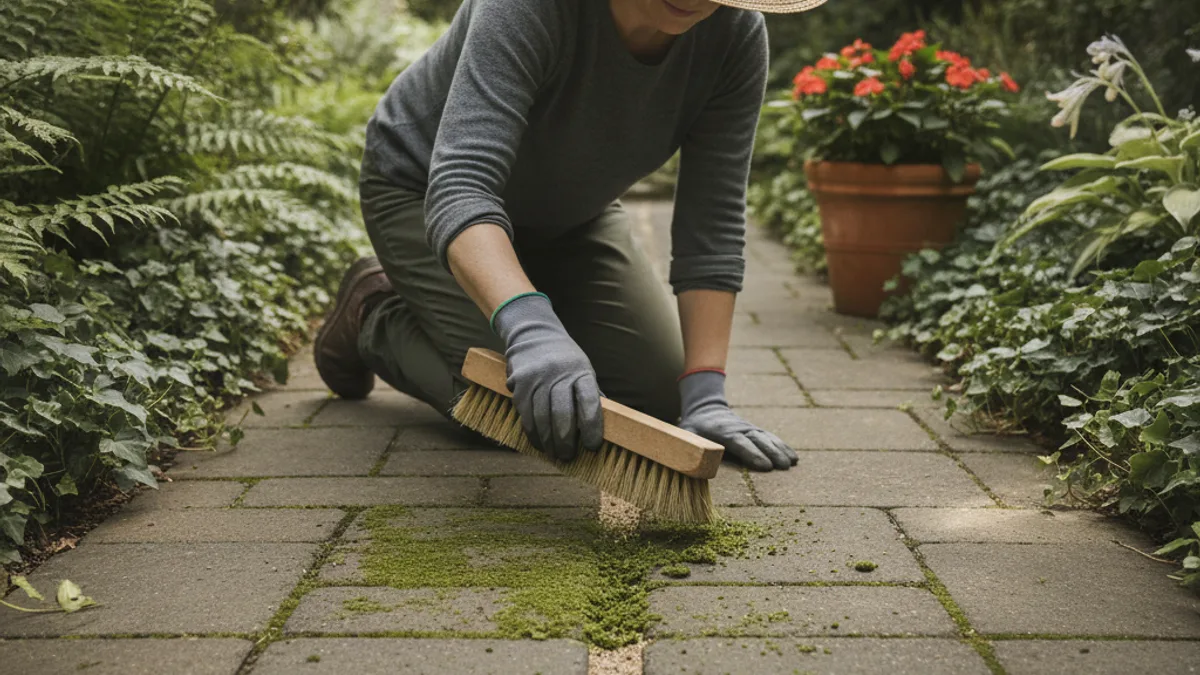
Start with a stiff-bristle brush and sweep the moss off the paver face. Work across the grain of the joints so you are not digging into them. This is slow, but it leaves the sand in place. If the moss is dry and brittle, it will lift off in clumps. If it is wet and rooted, you will need more than friction.
Step 1
Sweep off loose moss
Use a stiff push broom or hand brush to remove moss from pavers. Work when the pavers are dry — the moss breaks free more easily. Sweep debris into a pile and bag it; do not leave it on the surface to re-root.
Boiling Water for Small Patches
For moss between a few stones, boiling water works fast. Pour it directly onto the moss and watch it collapse and darken within minutes. The heat kills the plant without displacing the joint sand. This is the method I use for a single corner or a shaded step where moss has just started.
Step 2
Apply boiling water to targeted areas
Boil a kettle and pour the water slowly over the moss, saturating it completely. Let it sit for five minutes, then brush the dead moss away. Repeat if any green remains. This method is clean and does not introduce chemicals.
Vinegar Solution for Moderate Coverage
White vinegar at full strength will brown out moss over a few hours. Spray it on, let it dwell, then brush the dead material off. Vinegar does not kill the rhizoids, so the moss may return in a season or two. It is a surface fix, not a long-term solution, but it avoids harsher chemistry.
Step 3
Spray vinegar and allow dwell time
Fill a pump sprayer with undiluted white vinegar. Spray the moss until it is wet but not running off. Wait two to four hours, then scrub with a stiff brush. Rinse lightly if you are near plantings; vinegar will lower soil pH temporarily.
Low-Pressure Soft Wash with Surfactant
A surfactant-based cleaner applied at low pressure — under 500 psi — will lift moss without blowing out the joints. Let the chemistry do the work, not the water. I use a downstream injector to pull the surfactant into the stream, spray the pavers, wait fifteen minutes, then rinse at the same low pressure. The moss slides off and the sand stays put.
Step 4
Apply surfactant at low pressure
Mix a surfactant cleaner per the label and apply it with a pump sprayer or a pressure washer set to garden-hose pressure. Let it dwell for ten to twenty minutes — longer if the moss is thick. Rinse with a fan nozzle, holding the wand at a 45-degree angle to avoid driving water into the joints.
What I Do Not Recommend
I will not run 3,000 psi across pavers with a surface cleaner. You will get a clean surface and loose pavers that settle unevenly the first time it rains. Bleach does not kill moss rhizoids and will burn any plants downslope of the runoff. If a product claims to work without rinsing, read what it does to the joint sand — some binders will harden it into a crust that cracks.
Tips and Tricks for Effective Moss Removal
The work does not end when the moss is gone. Pavers need maintenance, and the conditions that grew moss the first time will grow it again if nothing changes.
Remove Loose Material Before You Treat
Before you apply any chemical or surfactant, sweep or scrape the bulk of the moss off the surface. A stiff brush or a flat scraper gets most of it. If you leave a thick mat on top, the treatment has to work through dead material before it reaches the live growth underneath, and you waste product. I scrape first, then treat what is left.
Change the Conditions That Favor Moss
Moss grows where it stays damp and shaded. If the pavers are under a tree canopy or against a north-facing wall, thin the branches overhead and trim back shrubs that block airflow. More light and better drainage mean less moss. I have seen paver patios stay clean for years after a single round of limbing up the oak that hung over them. You are not fighting biology; you are adjusting the habitat.
Expect Regrowth and Plan for It
Even after a thorough treatment, moss will return if the site stays damp and shaded. Some surfactant products claim a year to a year and a half before regrowth, and in drier climates that window can stretch to two or three years. That is not a permanent fix. Plan to inspect the pavers each fall and retreat the joints before the wet season starts. A light maintenance treatment is faster and cheaper than waiting until the moss is thick again.
The pavers do not decide when moss comes back — the microclimate does.
Do Not Over-Pressure the Joints
If you use a pressure washer to rinse after treatment, keep the nozzle at least twelve inches from the surface and use a wide fan tip. I run 1,500 psi or less on pavers, and I angle the spray across the joint, not into it. Blasting the joint out leaves a trench that fills with dirt and grows weeds faster than it grew moss. The joint sand is structural; treat it that way.
Test in a Corner First
Before you commit to a method across the whole patio, test it on a small section in a low-traffic corner. Let it sit for a week and check the joint. If the sand is stable and the moss is gone, the method is sound. If the joint is washed out or the pavers are discolored, adjust your approach before you damage the visible area.
Conclusion
Moss on pavers is a joint problem, not a surface problem. The spores settle in the sand between the stones, where water sits and shade keeps things damp. If you go after it with high pressure or a metal scraper, you will clear the moss and wreck the joint. The sand comes out, the pavers rock, and you have traded one problem for a worse one.
The method that works is the one that kills the moss where it lives without disturbing what holds the pavers in place. A stiff nylon brush, enough dwell time with a dilute hypochlorite solution, and a low-pressure rinse will handle most residential paver moss without touching the joint material. If the moss is thick or the pavers have been neglected for years, you may need two passes with a week between them. That is normal.
After you clean the pavers, look at why the moss grew there in the first place. If water pools on the surface or shade covers the area all day, the moss will come back next season. Fix the drainage, trim the canopy, or accept that you will be brushing moss every fall. There is no product that prevents it permanently without also preventing you from walking on the pavers.
I have cleaned estate patios and tasting-room walkways all over Sonoma Valley, and the properties that stay moss-free are the ones where someone checks the joints twice a year and addresses the small patches before they spread. A bucket, a brush, and twenty minutes in October will save you a weekend with a pressure washer in March. If the moss has already taken over or you are not sure what is holding your pavers together, call someone who knows the difference between cleaning and damage. The joints do not grow back.
Frequently asked questions
How do you remove moss from pavers without damaging the joints?
To remove moss from pavers without damaging the joints, use manual brushing with a stiff-bristle brush, apply boiling water or white vinegar to kill the moss, or use a low-pressure surfactant wash under 500 psi. Avoid high-pressure washing above 1,000 psi, which displaces the joint sand and destabilizes the pavers.
What kills moss on pavers permanently?
No treatment kills moss on pavers permanently if the site remains damp and shaded. Surfactant-based cleaners can prevent regrowth for one to three years depending on climate, but moss will return unless you improve drainage, increase sunlight exposure, and maintain regular inspections twice a year.
Can you pressure wash moss off pavers?
You can pressure wash moss off pavers only at low pressure — 1,500 psi or less — using a wide fan nozzle held at least twelve inches from the surface. High-pressure washing above 1,000 psi will blow out the joint sand, causing pavers to shift, settle unevenly, and create trip hazards.
Does vinegar remove moss from pavers?
White vinegar at full strength will brown out and kill moss on pavers over two to four hours, but it does not kill the rhizoids that anchor the plant. Moss treated with vinegar may return within one to two seasons. Vinegar is a surface fix that avoids harsher chemicals but is not a long-term solution.